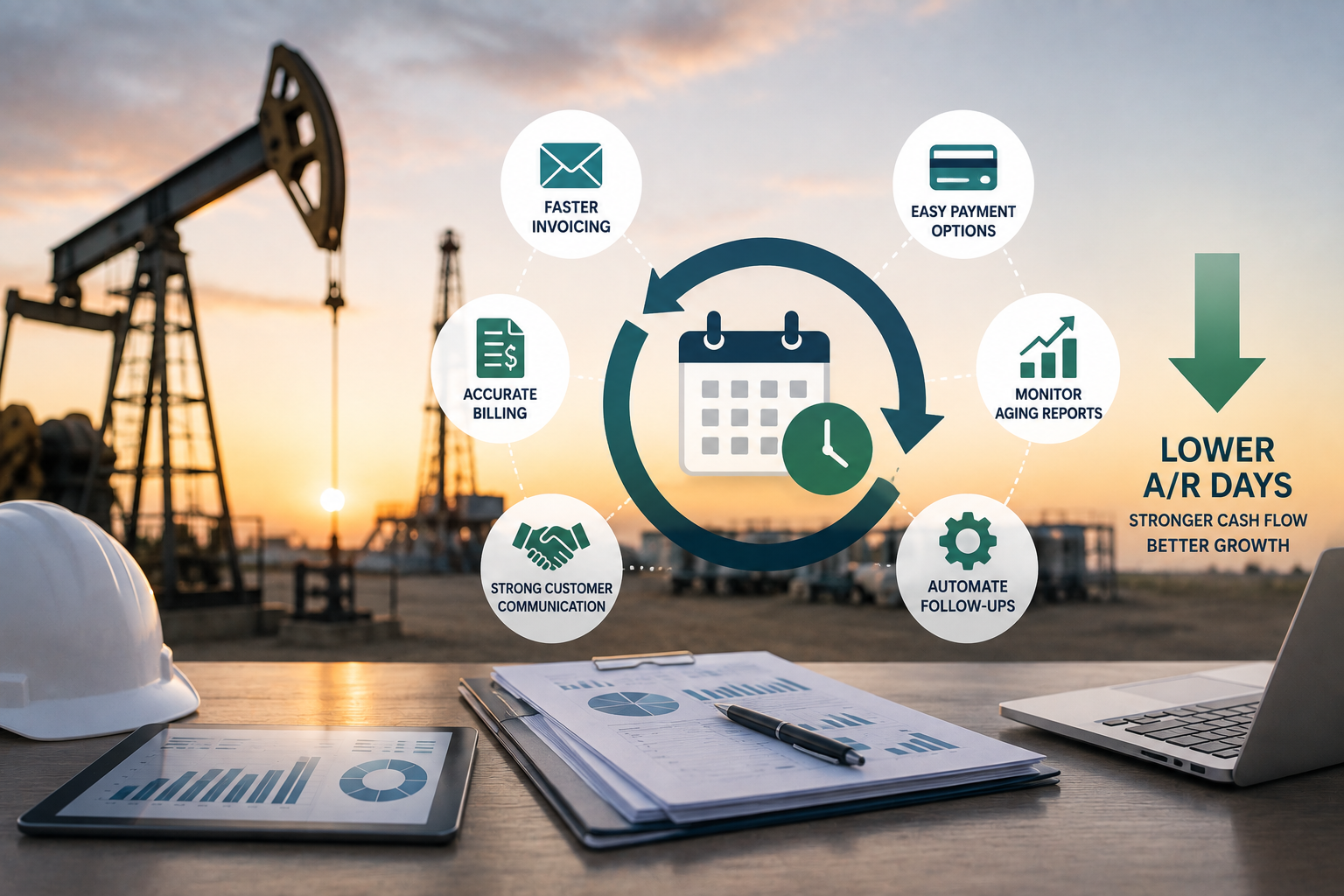
Reduce Accounts Receivable Oilfield: Improve Cash Flow

In oilfield service, you can have a full crew deployed, jobs closing on schedule, and a healthy order book, and still find yourself short on cash. The reason is often the same: the gap between completing a job and collecting payment is too wide. To reduce accounts receivable oilfield delays, companies need faster invoicing, accurate billing, and better payment follow-up processes.

The oil industry is notorious for taking 60 to 90 days to pay invoices. When your operation is already carrying the upfront cost of crews, equipment, fuel, and materials before collecting a dollar, that payment cycle puts real pressure on working capital. Reducing accounts receivable days, the average number of days between completing a job and receiving payment, is one of the most direct ways to improve cash position without adding revenue.

The good news is that for most oilfield service companies, a significant portion of that delay is not coming from customers. It is coming from internal processes that can be fixed.

Where AR Days Actually Come From

Before addressing accounts receivable days, it helps to understand where they are actually being lost. Most oilfield companies assume the problem is slow-paying customers. In reality, the biggest delays are usually internal.

The Gap Between Job Completion and Invoice Delivery

The more useful approach is to compare actual collection time with contracted terms. If customers agree to pay in 60 days but the company collects in 85, the extra 25 days indicate a process, documentation, dispute, or collection problem.

That extra 25 days is not the customer’s fault. It is the result of field tickets that take days to reach the office, manual data re-entry that introduces errors, and billing processes that cannot keep pace with job volume. Every day between job completion and invoice delivery is a day added to your AR cycle before the customer’s payment terms even begin.

Billing Errors That Trigger Disputes

When invoices go out with inaccurate information, customers dispute them. Disputed invoices do not get paid until the dispute is resolved, which adds days or weeks to the collection cycle on top of the original delay.

Most billing errors in oilfield service trace back to the same root cause: data captured on paper in the field gets manually re-entered into a billing system by someone who was not on the job. Transcription errors, missing service codes, incorrect equipment charges, and wrong rental periods all produce invoices that do not match what the customer experienced, and disputes follow.

Incomplete Field Documentation

Customers who receive an invoice without supporting documentation, a signed field ticket, a photo of completed work, or a clear record of equipment deployed, have grounds to delay payment pending verification. When field documentation is paper-based and attached manually to invoices, completeness and accuracy vary with whoever filled out the ticket that day.

How ofsERPĀ® Compresses the AR Cycle

ofsERPĀ®, built on Microsoft Dynamics 365 Business Central, addresses accounts receivable days by fixing the internal process gaps that create billing delay in the first place.

The results are measurable. One CBSi client saw their average invoice closed in days move from 83.7 to 13.0 in less than a year after implementation. That compression did not come from pushing customers to pay faster. It came from fixing the process between job completion and invoice delivery.

Paperless Field Ticketing That Feeds Directly Into Billing

With ofsERPĀ®, field crews capture time, materials, equipment usage, photos, and customer signatures digitally at the job site. That data flows directly into the billing workflow within Business Central without manual re-entry.

When a job is completed, the invoice data is already in the system, accurate and complete, ready for billing without waiting for paper tickets to arrive, be transcribed, and be verified. The days previously lost between field completion and invoice generation effectively disappear.

Invoicing just 10 days quicker increases cash on hand by $273,972 for every $10 million of annual revenue invoiced based on net terms. Accounts receivable decreases by the same amount.

For a detailed look at how those numbers work across different revenue levels and billing cycles, the proof and formulas behind billing efficiency break down the math in practical terms.

Accurate Invoices That Reduce Disputes

Because field data flows from the job site directly into invoicing without manual re-entry, the information on the invoice reflects what actually happened on the job. Service codes, equipment charges, rental periods, and labor hours are captured accurately at the source.

Accurate invoices get approved faster, disputed less often, and paid sooner. For oilfield service companies running high job volumes, even a modest reduction in dispute rate has a compounding effect on average AR days across the entire receivables portfolio.

Electronic Signatures and Photo Documentation Attached to Every Invoice

Customer signatures captured digitally at the job site are immediately attached to the ticket record in ofsERPĀ®. Photos documenting completed work, delivered equipment, and job site conditions are stored alongside the ticket and available to support the invoice.

When a customer questions an invoice, supporting documentation is available immediately rather than requiring someone to locate a paper ticket that may have been filed, lost, or never properly attached in the first place. That documentation availability reduces the time disputes take to resolve and removes the leverage customers have to delay payment pending verification.

Real-Time AR Visibility That Supports Proactive Collections

ofsERPĀ® gives your billing team real-time visibility into the accounts receivable pipeline, including which invoices are outstanding, how long they have been open, and which accounts are approaching or past their payment terms.

That visibility supports proactive follow-up rather than reactive collections. When an invoice is approaching its due date without payment, your team knows before it becomes overdue rather than discovering it during a manual AR review. Earlier follow-up consistently produces earlier payment and reduces the average days outstanding across the portfolio.

The Compounding Effect of Tighter Billing Cycles

Reducing AR days does not just improve cash flow on individual invoices. It changes the cash position of the entire business on an ongoing basis.

When billing consistently goes out within days of job completion rather than weeks, the receivables balance at any given point reflects a shorter window of outstanding work. That means more of the revenue your operation is generating is available as working capital rather than sitting in unpaid invoices.

For oilfield service companies carrying the upfront cost of field operations before collecting payment, that shift in working capital availability changes what the business can do. It supports faster equipment purchases, more confident hiring decisions, and the ability to take on larger contracts without straining cash position.

The broader cash flow strategies that consistently separate high-performing oilfield companies from the rest almost always include a tight, accurate, automated billing process as the foundation.

Fixing AR Days Is an Internal Problem With an Internal Solution

Most oilfield service companies that struggle with high AR days are not at the mercy of slow-paying customers. They are losing days internally, in the gap between field completion and invoice delivery, in billing errors that trigger disputes, and in collections processes that react to problems rather than preventing them.

ofsERPĀ® fixes those internal gaps. CBSi brings over 17 years of oilfield ERP implementation experience and more than 30 years of combined expertise in Microsoft Dynamics NAV and Business Central. Learn more about why oilfield companies choose CBSi, explore CBSi’s full range of ERP services, and review the ofsERPĀ® FAQ for more detail on how the platform handles billing automation and AR management.

Ready to Take Your Business to the Next Level?

The key is to start with what matters most to your business today, apply it consistently, and build from there. If you are ready to take your business to the next level, call 800-455-5915 or schedule a call!
QuickBooks vs Business Central for Oilfield: When Oilfield Service Companies Outgrow Their Accounting Software

QuickBooks is where a lot of oilfield service companies start. It is affordable, familiar, and gets the job done when the business is small enough that a straightforward accounting tool covers most of what you need.

The problem is that oilfield service companies do not stay small. Jobs multiply. Crews expand. Equipment fleets grow. Service lines diversify. And at some point, the system that handled accounting for a five-person operation starts showing serious strain under the weight of a twenty, fifty, or hundred-person business running multiple lines of service across several job sites simultaneously.

That moment, when QuickBooks stops being a solution and starts being a constraint, is the moment the conversation about Microsoft Dynamics 365 Business Central with ofsERPĀ® becomes worth having.

What QuickBooks Does Well for Early-Stage Oilfield Companies

It is worth being clear about this. QuickBooks is genuinely useful for oilfield service companies in their early stages, and the companies that start with it are not making a mistake.

For a small operation focused primarily on invoicing customers, paying vendors, tracking expenses, and producing basic financial reports, QuickBooks handles those tasks reliably and at a price point that makes sense for a business still finding its footing.

The limitations are not apparent immediately. They emerge gradually as the business grows and the gap between what QuickBooks was designed to do and what the business actually needs widens to the point where it can no longer be bridged by workarounds.

The Signs You Have Outgrown QuickBooks

Most oilfield service companies do not make the decision to move off QuickBooks because of a single breaking point. They make it because a pattern of limitations has been accumulating long enough that the cost of staying has become greater than the cost of changing.

Your Financial Data Lives in Too Many Places

QuickBooks handles accounting. It does not handle field ticketing, equipment tracking, rental order management, or job costing in any meaningful way for oilfield operations. As a result, oilfield companies running QuickBooks inevitably build a surrounding ecosystem of spreadsheets, separate field service apps, equipment tracking tools, and manual processes to cover the gaps.

The more that ecosystem grows, the more time your team spends moving data between systems, reconciling discrepancies, and managing integrations that were never designed to work together. That overhead compounds as job volume increases, and the administrative burden of holding the patchwork together starts consuming resources that should be going toward the operation itself.

Job Costing Is Impossible to Do Accurately

QuickBooks offers basic job costing functionality, but for oilfield service companies managing labor, materials, equipment usage, and overhead across multiple simultaneous jobs at different locations, that basic functionality falls well short of what is needed.

When you cannot accurately track what each job actually costs in real time, you cannot know which jobs are profitable and which are quietly eroding your margin. Pricing decisions get made on incomplete information. Underperforming jobs do not get identified until month-end reporting, when the opportunity to address them has already passed.

The impact on revenue growth is direct. Companies that cannot see their job-level profitability are making growth decisions based on aggregate financials that may look healthy while individual jobs underperform.

Equipment Management Is Handled Outside the System

QuickBooks has no meaningful equipment asset management capability. For oilfield service companies whose fleet is their primary revenue-generating asset, that gap is significant.

Equipment location, availability, utilization, maintenance history, and rental status all have to be managed in separate tools or spreadsheets. The result is the visibility problem that oilfield equipment asset management articles consistently identify as one of the most costly operational gaps in the industry: you do not know where your equipment is, whether it is available, or whether it is being utilized at a rate that justifies its cost on the balance sheet.

Billing Delays Are Becoming a Cash Flow Problem

In QuickBooks, the billing process depends on information that has to come from somewhere else. Field tickets have to be collected, data has to be entered manually, and the gap between job completion and invoice delivery grows with every step that requires human intervention.

For oilfield service companies trying to improve cash flow, that billing lag is one of the most direct contributors to receivables buildup. The proof and formulas behind billing efficiency make clear how significantly even modest reductions in billing cycle time translate into measurable cash flow improvement.

Reporting Does Not Give You What You Actually Need

QuickBooks produces standard financial reports. It does not produce the operational reporting that oilfield service companies need to run their business effectively: equipment utilization by asset, job profitability by service line, billing cycle performance, field ticket status across active jobs, or revenue by crew and location.

Getting those insights from QuickBooks requires exporting data, building reports in Excel, and spending time on analysis that should be available within the system itself. As the business grows, that reporting gap becomes a decision-making gap. Leadership is operating on incomplete information because the system cannot surface what they actually need to see.

The System Cannot Scale With Your Operation

QuickBooks was built for small business accounting. It was not built to support a growing oilfield service company managing hundreds of jobs, a large equipment fleet, multiple service lines, and a team that spans the field and the office.

As your operation grows, the limitations of QuickBooks do not just persist. They compound. More jobs mean more manual data entry. More equipment means more spreadsheets. More service lines mean more reconciliation. The administrative overhead required to keep QuickBooks functional at scale grows faster than the revenue that is supposed to be supporting it.

What Business Central With ofsERPĀ® Does Differently

Microsoft Dynamics 365 Business Central with ofsERPĀ® is not just a bigger version of QuickBooks. It is a fundamentally different approach to running an oilfield service business.

Everything in One Connected System

Rather than a core accounting tool surrounded by disconnected workarounds, Business Central with ofsERPĀ® is a single environment where field operations, equipment management, billing, inventory, and financials all share the same data in real time.

Field tickets submitted by a crew in the field flow directly into invoicing without manual re-entry. Equipment usage captured on a job site flows directly into job costing. Rental orders, service orders, repair orders, and sale orders all run through the same system with distinct order types that reflect how oilfield companies actually operate. There is no ecosystem of separate tools to manage and no reconciliation process between systems that were never designed to work together.

Real-Time Job Costing That Protects Margin

ofsERPĀ® connects labor, materials, equipment usage, and overhead to individual jobs as they happen. Your team can see what each job is actually costing in real time, not at month end when the numbers have already been locked in.

That visibility directly supports better pricing decisions, earlier identification of margin erosion, and more informed conversations with customers about scope changes before they affect profitability. For oilfield companies focused on cost reduction, real-time job costing is one of the most effective tools available.

Equipment Management Built Into the Platform

Every piece of equipment in your fleet has a complete record in ofsERPĀ®, covering its full deployment history, maintenance log, repair records, utilization data, and current status. Scheduling is based on real availability information rather than phone calls. Maintenance is preventive rather than reactive. Fleet decisions are based on utilization data rather than intuition.

That level of equipment visibility is simply not possible in QuickBooks, and it makes a measurable difference in how efficiently your fleet generates revenue.

Billing That Keeps Pace With Operations

Because paperless field ticketing connects directly to invoicing in ofsERPĀ®, the gap between job completion and invoice delivery shrinks dramatically. Billing keeps pace with operations rather than lagging behind them, which means receivables build up more slowly and cash flow reflects your actual job activity rather than a delayed version of it.

Reporting That Surfaces What You Actually Need

Business Central with ofsERPĀ® produces operational and financial reporting that reflects how oilfield service companies think about their business. Equipment utilization, job profitability, billing cycle performance, crew productivity, and financial summaries are all available within the system without requiring manual exports or external analysis tools.

Microsoft Copilot, built into Business Central, extends that reporting capability further by allowing your team to ask questions in plain language and receive immediate answers from live operational data. The Microsoft Copilot in Business Central overview explains how this AI capability works in practice.

A Platform That Scales Without Friction

ofsERPĀ® currently supports oilfield service companies with 5 to 400 users. Adding users, expanding service lines, and growing job volume does not require a system change or a significant increase in administrative overhead. The platform scales with your business because it was built for businesses at the scale your operation is heading toward, not just the scale it is at today.

The Migration From QuickBooks to Business Central

Moving from QuickBooks to Business Central is a significant operational transition, and it is worth approaching it with the same seriousness as any major business decision.

The good news is that CBSi has guided oilfield service companies through this transition many times. The migrating to Business Central guide covers the key steps, common challenges, and what a well-managed migration looks like in practice. CBSi’s approach starts with a thorough assessment of your current data and workflows before any migration work begins, which means the system you go live on is configured correctly from day one rather than requiring significant adjustment after the fact.

CBSi brings over 17 years of oilfield ERP implementation experience and more than 30 years of combined expertise in Microsoft Dynamics NAV and Business Central to every migration it manages. That depth of experience reduces the risk that comes with any major system transition and ensures the new platform is built around how your oilfield operation actually works rather than a generic business template. Learn more about why oilfield companies choose CBSi and explore the full range of ERP services CBSi provides from assessment through go-live and beyond.

QuickBooks vs Business Central Oilfield

The honest answer is that most oilfield service companies wait longer than they should. The limitations of QuickBooks build gradually, and because each individual workaround seems manageable in isolation, the cumulative cost of staying on an inadequate system does not always feel urgent until it becomes impossible to ignore.

The right time to evaluate Business Central with ofsERPĀ® is before the limitations of your current system start actively constraining your growth, not after they have already cost you jobs, margin, or customers.

If any of the patterns described in this article feel familiar, that is a signal worth paying attention to sooner rather than later. The ofsERPĀ® FAQ is a useful starting point for understanding how the platform addresses the specific operational challenges that QuickBooks cannot handle for oilfield service companies.

Ready to Take Your Oilfield Business to the Next Level?

The key is to start with what matters most to your business today, apply it consistently, and build from there. If you are ready to take your oilfield business to the next level, call 800-455-5915 or schedule a call!
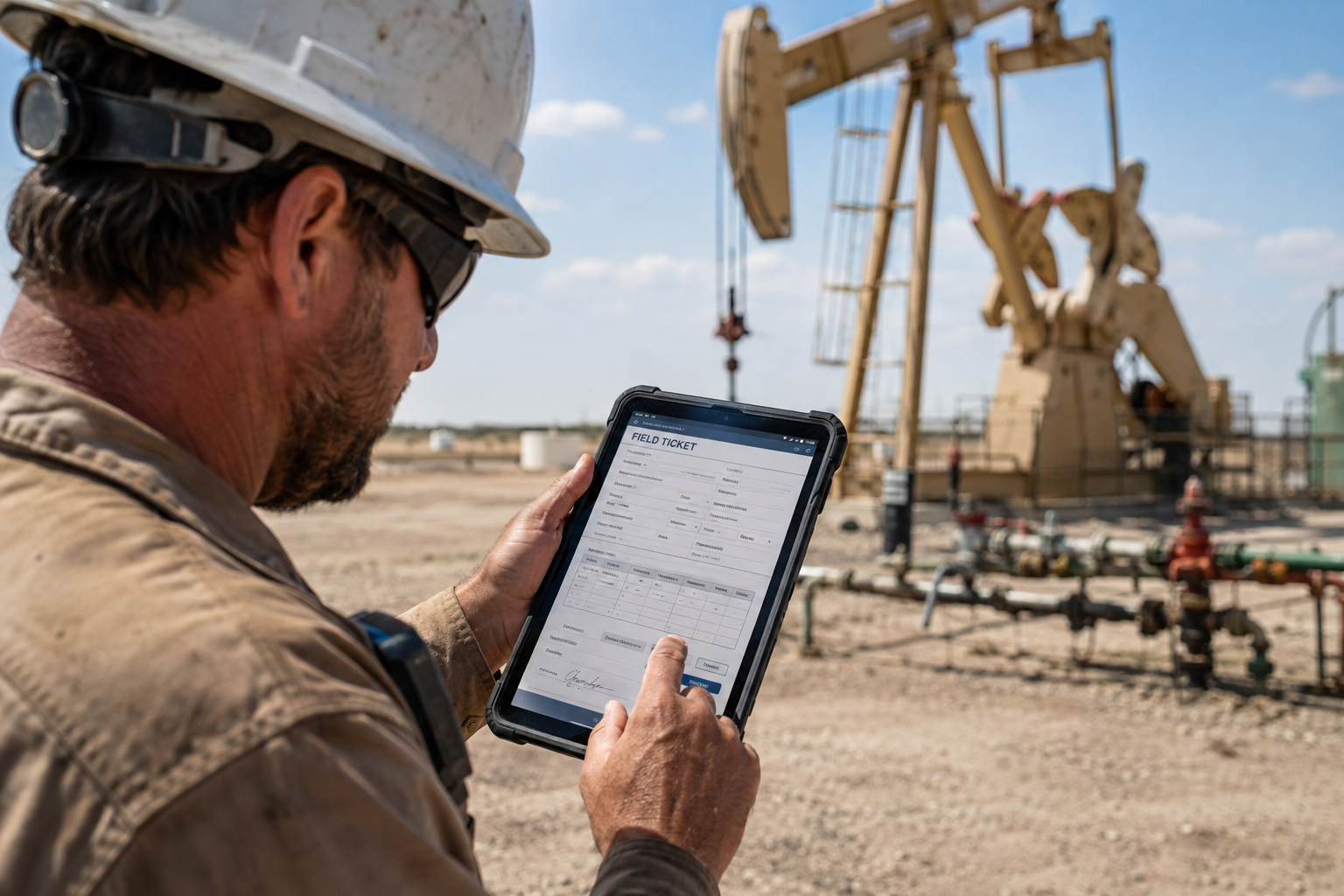
Microsoft Dynamics 365 Business Central for Oilfield Service Companies: A Complete Guide

If you are evaluating ERP software for your oilfield service company, Microsoft Dynamics 365 Business Central oilfield solutions are likely already on your radar. It is one of the most widely adopted mid-market ERP platforms in the world, backed by Microsoft’s infrastructure, regularly updated, and built to scale alongside growing businesses.

But for oilfield service companies specifically, the question is not just whether Business Central is a good ERP. The question is whether it can handle the operational complexity that makes oilfield service different from every other industry it serves.

The answer is yes, but with an important condition. Business Central on its own is a powerful platform. Business Central configured with ofsERPĀ®, CBSi’s purpose-built oilfield extension, is a system that was designed specifically for how oilfield service companies operate.

This guide covers what Business Central actually does, where it fits for oilfield service, what ofsERPĀ® adds to the platform, and what to expect from implementation.

What Is Microsoft Dynamics 365 Business Central?

Microsoft Dynamics 365 Business Central is a cloud-first ERP platform built for small to mid-sized businesses. It handles financials, operations, sales, purchasing, inventory, and reporting within a single connected environment, all running on Microsoft’s Azure cloud infrastructure.

Business Central is the successor to Microsoft Dynamics NAV, one of the most widely implemented ERP platforms in history. Companies that have been running NAV for years are increasingly migrating to Business Central as Microsoft continues investing in the cloud-first platform and winding down legacy support for older NAV versions.

As a cloud platform, Business Central receives automatic updates twice a year from Microsoft, which means the system continuously improves without requiring internal IT resources to plan and execute upgrades. Security, infrastructure, and platform maintenance are handled at the Microsoft level, freeing your team to focus on running the business rather than managing the software environment.

For a broader look at what Business Central offers and how it compares to other options, the Business Central features overview on the CBSi site covers the platform’s core capabilities in detail.

Why Business Central Alone Is Not Enough for Oilfield Service

Business Central is an exceptional platform for a wide range of industries. Out of the box, it handles general financial management, basic inventory, purchasing, sales orders, and standard reporting with a high degree of capability and reliability.

What it does not do out of the box is handle the workflows that are specific to oilfield service operations.

Field ticket management, equipment asset tracking across job sites, oilfield rental order management, cradle-to-grave equipment history, and job costing tied to field crew activity are not native Business Central capabilities. They require either heavy customization of the base platform, which introduces risk and maintenance burden, or an industry-specific extension built to handle those workflows without modifying the core system.

This is precisely the problem ofsERPĀ® was designed to solve.

What Microsoft Dynamics 365 Business Central Oilfield Adds for Oilfield Service?

ofsERPĀ® is a Microsoft AppSource-certified extension suite built natively on Business Central. It adds oilfield-specific functionality to the platform without modifying the underlying Business Central code, which means your system continues receiving Microsoft updates without interruption and without the risk of customizations breaking when new versions are released.

Oilfield Order Types Within a Single System

One of the most operationally significant things ofsERPĀ® adds to Business Central is a structured approach to oilfield order types. Rather than using Business Central’s native Service Management module, which was built for a different use case and requires a Premium license, ofsERPĀ® uses Business Central’s existing Sales Order tables with distinct order types for Sale, Service, Rental, and Repair orders.

That structure means every line of your oilfield business runs through the same system. A customer who receives rental equipment, has it serviced in the field, gets a repair done at your facility, and eventually purchases a piece of equipment has every transaction connected in one place, under one customer record, visible to your billing team without switching between systems or reconciling data manually.

Paperless Field Ticketing Connected to Billing

Field crews capture time, materials, equipment usage, photos, and customer signatures digitally at the job site. That data flows directly into the billing workflow within Business Central without manual re-entry, eliminating the transcription errors and billing delays that paper-based ticketing systems introduce.

The connection between paperless field ticketing and billing accuracy is one of the most immediate operational improvements oilfield companies notice after implementing ofsERPĀ®. Invoices go out faster, disputes happen less often, and the billing cycle tightens in ways that directly improve cash flow.

Equipment Asset Management Across the Full Fleet

ofsERPĀ® tracks every piece of equipment in your fleet from acquisition through retirement, maintaining a complete record of deployment history, maintenance logs, repair records, inspection documentation, and utilization data within a single asset record in Business Central.

For oilfield service companies managing large fleets across multiple job sites, that visibility changes how fleet decisions are made. Scheduling is based on real availability data rather than phone calls. Maintenance is preventive rather than reactive. Utilization is measured rather than estimated. The full operational and financial picture of your oilfield equipment asset management is always current and always accessible.

Job Costing That Reflects Real Field Activity

ofsERPĀ® connects labor, materials, equipment usage, and overhead to individual jobs in real time, giving your team accurate cost visibility throughout the life of each project. That real-time job costing is one of the most important capabilities for oilfield companies trying to protect margin as job volume and complexity increase.

When job costs are visible as they accumulate rather than at month end, margin erosion is easier to catch and address before the opportunity to do so has passed.

AI-Powered Inventory Management

Because ofsERPĀ® runs on Business Central, your inventory management benefits from Microsoft’s AI capabilities built into the platform. Demand forecasting, automated reorder recommendations, anomaly detection, and real-time visibility across multiple locations are all available within the same environment as your field operations and financials.

For a detailed look at how AI is changing inventory management for oilfield service companies, the AI in inventory management article covers these capabilities in depth.

Microsoft Copilot Built Into the Platform

Business Central includes Microsoft Copilot, an AI assistant that allows your team to interact with operational and financial data in plain language. Rather than navigating reports manually, your team can ask questions and receive immediate, data-driven answers drawn from your live Business Central data.

The Microsoft Copilot in Business Central overview explains how these AI capabilities work within the platform and where they deliver the most practical value for oilfield service operations.

Who Business Central With ofsERPĀ® Is Built For

ofsERPĀ® currently supports oilfield service companies with 5 to 400 users. The platform is designed to scale alongside your business without requiring a system change as you grow.

It is a particularly strong fit for companies that are currently running on QuickBooks, outdated legacy ERP systems, or a patchwork of disconnected tools and are starting to feel the operational constraints that come with outgrowing those solutions. It is also the right choice for companies already running on older versions of Microsoft Dynamics NAV who are evaluating a migration to Business Central and want to add oilfield-specific functionality in the process.

Cloud or On-Premise: Your Choice

Business Central is a cloud-first platform, and for most oilfield service companies the cloud deployment model delivers the best combination of accessibility, reliability, and total cost of ownership. Field crews can submit tickets from any location. Management can access reporting from any device. The infrastructure is maintained by Microsoft rather than your internal IT team.

For companies with specific data sovereignty requirements or operational constraints that make cloud deployment complicated, CBSi also offers Azure-hosted deployment options that provide cloud-level performance and security within a more controlled environment. The cloud ERP vs on-premise ERP comparison covers the trade-offs between these options in detail so you can make the right choice for your specific situation.

What Implementation Looks Like With CBSi

Choosing the right platform is only part of the decision. The implementation partner guiding the process determines whether the platform actually delivers on its promise.

CBSi brings over 17 years of oilfield ERP implementation experience and more than 30 years of combined expertise in Microsoft Dynamics NAV and Business Central. That depth of industry knowledge means every implementation decision, from data migration to workflow configuration to user training, is informed by real experience with how oilfield service companies operate.

CBSi’s ERP implementation approach starts with a thorough assessment of your current system, your data, and your operational workflows before any configuration work begins. That upfront clarity reduces the risk of surprises during implementation and ensures the system is built around how your business actually runs, not around a generic template that has to be adapted after go-live.

For companies that have experienced ERP implementation problems in the past, the ERP implementation mistakes article covers the most common failure points and how CBSi’s approach avoids them.

Why Business Central With ofsERPĀ® Is the Right Platform for Oilfield Service

The combination of Microsoft’s platform reliability and ofsERPĀ®’s oilfield-specific functionality creates something that neither delivers independently: an ERP that is both enterprise-grade and purpose-built for the way oilfield service companies actually operate.

You get the security, scalability, and continuous improvement of a Microsoft platform alongside field ticketing, equipment asset management, oilfield order types, and job costing workflows that were designed for your industry from the ground up.

For oilfield service companies that have been making do with systems that were never built for their operation, that combination is the difference between software that supports the business and software that holds it back.

Learn more about why oilfield companies choose CBSi and explore the ofsERPĀ® FAQ for detailed answers to the most common questions about how the platform handles oilfield-specific workflows and requirements.

Ready to Take Your Oilfield Business to the Next Level?

The key is to start with what matters most to your business today, apply it consistently, and build from there. If you are ready to take your oilfield business to the next level, call 800-455-5915 or schedule a call!

Paperless Field Ticketing Oilfield: Reduce Billing Errors

For most oilfield service companies, the billing process does not break down in accounting. It often starts much earlier, when a field ticket is created on a job site and begins its slow, error-prone journey back to the office. Paperless field ticketing oilfield workflows help capture accurate job data at the source, reducing the risk of missing information, manual entry mistakes, and billing delays.

Paper tickets get lost, damaged, or filled out incompletely. Photos of handwritten tickets arrive illegible. Information gets re-entered manually by someone who was not on the job. By the time an invoice is generated, the data has passed through enough hands that discrepancies are almost inevitable.

The result is a billing cycle that moves slower than your operation, generates disputes that delay payment, and requires more back-office effort than it should. For oilfield service companies running high job volumes, those inefficiencies compound quickly.

Paperless field ticketing, built into ofsERPĀ® on Microsoft Dynamics 365 Business Central, addresses the problem at the source rather than trying to manage the fallout downstream.

Why Paper Field Tickets Create Billing Problems

The field ticket is the foundation of every oilfield service invoice. Everything that gets billed traces back to what was captured at the job site. When that capture process is paper-based, the risk of error enters the billing cycle from the very beginning.

Incomplete or Illegible Information

Handwritten field tickets are only as accurate as the conditions they are filled out in. A crew finishing a job at the end of a long day, in low light, on an uneven surface, is not in the best position to produce a clean, complete, legible ticket. Missing service codes, unclear quantities, and illegible handwriting are not exceptions in paper-based ticketing systems. They are expected occurrences that someone in the office has to chase down and correct before billing can proceed.

Every ticket that requires follow-up adds time to the billing cycle. In a high-volume operation, the cumulative delay is significant.

Manual Re-Entry Introduces New Errors

Even a perfectly filled out paper ticket introduces risk the moment it has to be re-entered into an accounting or billing system. Manual data entry is inherently error-prone. A transposed number, a wrong service code, or a quantity entered against the wrong job can all produce an invoice that does not match what actually happened in the field.

Those mismatches do not just cause internal reconciliation work. They cause customer disputes that delay payment and require additional effort to resolve on both sides.

No Real-Time Visibility Into Job Status

With paper-based ticketing, the office has no visibility into what is happening in the field until the ticket physically arrives. There is no way to know whether a job has been completed, whether all required information has been captured, or whether a ticket is sitting in a truck waiting to be dropped off.

That visibility gap means billing cannot begin until the ticket arrives, which adds days to the cycle before any invoice work has started.

Lost and Delayed Tickets

Paper tickets get lost. They get left in trucks, misplaced during handoff, or damaged before they reach the office. When a ticket cannot be located, the entire billing process for that job stalls while someone attempts to reconstruct what happened from memory or secondary records.

In an operation running dozens or hundreds of jobs per week, even a small percentage of lost or delayed tickets represents a meaningful amount of unbilled work sitting in limbo at any given time.

How Paperless Field Ticketing Oilfield Works in ofsERPĀ®

ofsERPĀ® replaces the paper ticket process with a fully digital workflow that connects field data capture directly to billing, without manual re-entry or physical handoff.

Field Crews Capture Everything Digitally at the Job Site

Using a mobile device, field crews enter time, materials, equipment usage, and service details directly into the system at the job site. Required fields enforce completeness before a ticket can be submitted, which means incomplete tickets cannot enter the billing pipeline in the first place.

Crews can also attach photos, capture customer signatures electronically, and add job notes directly to the digital ticket. Everything needed to generate an accurate invoice is captured at the source, by the people who were actually on the job.

Data Flows Directly Into Billing Without Re-Entry

Once a field ticket is submitted, the data moves directly into the billing workflow within ofsERPĀ®. There is no manual re-entry step, no transfer between systems, and no opportunity for transcription errors to enter the process.

Because ofsERPĀ® runs on Microsoft Dynamics 365 Business Central, field data and financial data share the same environment. The information captured on a job site is immediately available to the billing team without any intermediate steps.

Real-Time Visibility for Office and Management

As soon as a field ticket is submitted, the office can see it. Management has real-time visibility into job completion status, outstanding tickets, and billing pipeline without waiting for physical paperwork to arrive.

That visibility allows billing to begin as soon as a job is complete rather than after the ticket makes its way back to the office. For oilfield service companies trying to improve cash flow, that compression of the billing cycle has a direct and immediate impact on receivables.

Electronic Signatures and Photo Documentation

Customer signatures captured electronically at the job site are legally valid and immediately attached to the ticket record. There is no need to chase down a signature after the fact or dispute whether a customer approved the work.

Photo documentation attached to digital tickets provides additional support for invoices, reducing the back-and-forth that often accompanies billing disputes over what was actually done on a job.

The Billing Impact of Going Paperless

The connection between paperless field ticketing and billing performance is direct and measurable.

When tickets are complete and accurate at the point of capture, invoices can be generated faster and with greater confidence. When data flows automatically from field to billing without manual re-entry, the risk of transcription errors disappears. When customers receive invoices that accurately reflect what happened on the job, disputes happen less often and payment follows more predictably.

For a detailed look at how billing efficiency improvements translate into measurable cash flow gains, the proof and formulas behind billing efficiency break down exactly how those numbers work in an oilfield service context.

The broader cost reduction impact of reducing manual processing, rework, and dispute resolution is also significant. Administrative time that was previously spent tracking down missing tickets, correcting data entry errors, and resolving billing discrepancies gets redirected toward work that actually moves the business forward.

Why the Platform Underneath Matters

Paperless field ticketing is only as effective as the system it feeds into. A digital ticket that still requires manual transfer into a separate billing or accounting system has solved the legibility problem but not the re-entry problem.

ofsERPĀ® addresses both because field ticketing and billing run within the same Business Central environment. The data does not move between systems. It moves between modules of the same system, which means accuracy is maintained end to end without any additional integration layer to manage or maintain.

CBSi brings over 17 years of oilfield ERP implementation experience and more than 30 years of combined expertise in Microsoft Dynamics NAV and Business Central. That depth of knowledge means the ticketing and billing workflows are configured around how oilfield service companies actually operate, not around a generic service management template. You can learn more about why oilfield companies choose CBSi and explore the full range of services CBSi provides, from implementation and training to data migration and ongoing support.

If you have specific questions about how ofsERPĀ® handles field ticketing, the ofsERPĀ® FAQ covers the platform’s oilfield-specific capabilities in detail.

Paperless Ticketing Is Where Billing Accuracy Starts

You cannot fix billing errors downstream if the problem starts upstream at the ticket. The most efficient invoicing process in the world cannot compensate for incomplete, illegible, or manually re-entered field data that was inaccurate before it ever reached accounting.

Paperless field ticketing with ofsERPĀ® fixes the problem at the source, so the data that reaches billing is complete, accurate, and ready to invoice without additional handling. That shift alone can meaningfully reduce billing cycle time, lower dispute rates, and improve cash flow across the operation.

Ready to Take Your Oilfield Business to the Next Level?

The key is to start with what matters most to your business today, apply it consistently, and build from there. If you are ready to take your oilfield business to the next level, call 800-455-5915 or schedule a call!
21 Oilfield Service Strategies to Increase Profitability (And How to Actually Apply Them)

Running an oilfield service business means dealing with constant pressure—tight margins, rising costs, and a market that can shift without warning. You can be busy and still struggle financially if your operations aren’t structured to support profitability.

The companies that stay profitable aren’t just reacting to the market. They’re intentional about how they generate revenue, how they control costs, and how they manage cash flow. They pay attention to the small details that, over time, make a significant difference.

If you want to improve profitability, you need to approach it from three angles: revenue, cost, and cash flow. The strategies below are not theories—they are practical decisions that businesses in this space use every day.

Revenue Strategies: Building Income That Actually Holds Up

1. Build Customer Relationships That Keep You in Business

When activity slows down, the companies that survive are usually the ones that have strong, consistent relationships with their clients. It is not just about doing a good job once.. it is about being dependable over time.

Clients remember how you respond when problems come up. They remember whether you communicate clearly and whether your team delivers consistently. That trust becomes your advantage when budgets tighten and they have to choose who to keep working with.

This means your focus should not stop after closing a deal. Stay engaged with your clients. Understand their challenges. Be proactive. The goal is to position your company as the reliable choice, not just an available option.

2. Expand Services Around What You Already Offer

Many companies look for growth by chasing new clients, but often the better opportunity is right in front of them. Your existing clients already trust you, and they likely have needs that go beyond the service you currently provide.

If you are already involved in operations, consider whether you can support maintenance, equipment handling, or logistics. These additional services do not require building a new market—they build on relationships you already have.

This approach increases your revenue per client and reduces the cost of acquiring new business. Over time, it also strengthens your position as a long-term partner instead of a one-time service provider.

3. Diversify to Reduce Dependence on One Market

Oil and gas is known for its cycles. When demand drops, companies that rely entirely on this sector feel the impact immediately.

Diversifying into related industries can create stability. Construction, transportation, and infrastructure projects often continue even when oil activity slows. If your capabilities can be applied in those areas, it is worth exploring.

Even a small portion of revenue from other industries can help balance your cash flow and reduce overall risk.

4. Approach Pricing With Structure, Not Urgency

Lowering prices to win work can seem like the quickest solution during slow periods, but it can create long-term problems. Once clients expect lower pricing, it becomes difficult to raise it again.

Instead, structure your pricing in a way that protects your margins. Tie discounts to longer contracts or higher volumes. Include terms that allow adjustments when market conditions change.

This allows you to stay competitive without weakening your financial position.

5. Bundle Services to Increase Value Per Client

Clients prefer simplicity. Managing multiple vendors creates more work for them, so if you can provide a complete solution, you become more valuable.

Bundling services allows you to present a more comprehensive offering. Instead of selling individual services, you position your business as a single solution that covers multiple needs.

This often leads to higher revenue per project and stronger client relationships, because you become more integrated into their operations.

6. Use Market Conditions to Grow Through Acquisition

When the market slows, some companies struggle to stay afloat. For businesses in a stronger position, this creates an opportunity.

Acquiring or merging with another company can expand your capabilities, increase your customer base, and reduce competition. It also allows you to combine resources and reduce overlapping costs.

While this is not a decision to take lightly, it can be one of the most effective ways to grow during a downturn.

7. Increase Equipment Utilization Instead of Buying More

One of the most common issues in oilfield operations is underutilized equipment. Assets that are sitting idle represent money that is not being recovered.

Instead of investing in new equipment, start by evaluating how your current assets are being used. Identify what is underutilized and find ways to deploy it more effectively.

Better utilization leads directly to higher profitability without increasing capital expenses.

8. Track Equipment to Prevent Revenue Loss

Poor tracking leads to more problems than most companies realize. Equipment can go missing, usage may not be recorded, and billing can become inaccurate.

Implementing proper tracking systems allows you to know exactly where your equipment is and how it is being used. This ensures that all billable usage is captured and reduces the risk of loss.

Accurate tracking is not just an operational improvement—it is a financial safeguard.

9. Eliminate Billing Errors From Field Work

Manual processes often lead to missed revenue. When field tickets are incomplete, lost, or difficult to read, it becomes easy to overlook billable items.

Digitizing this process allows your team to record work in real time, ensuring that every service, piece of equipment, and material is accounted for.

This leads to more accurate invoices, faster billing, and fewer disputes with clients.

Cost Reduction Strategies: Lowering Expenses Without Weakening the Business

10. Review Every Expense With a Critical Perspective

Costs tend to accumulate over time, especially during periods of growth. Expenses that once made sense may no longer be necessary.

Taking the time to review each line item in your financial statements can reveal areas where money is being spent without clear value. This process is not about cutting everything—it is about making intentional decisions.

11. Reduce Non-Essential Spending First

Some expenses can be reduced quickly without affecting operations.

  • travel and accommodations
  • entertainment expenses
  • unused subscriptions

These adjustments may seem small individually, but together they can free up a noticeable amount of cash.

12. Consider In-House Solutions Where Practical

Outsourcing and renting are convenient, but they are not always the most cost-effective options.

If your business has the capability, bringing certain processes in-house can reduce long-term costs and give you more control over quality and timing.

13. Align Workforce Levels With Actual Demand

Labor is often the largest expense in an oilfield service company. When workload decreases, costs can quickly become unbalanced.

Regularly evaluating staffing levels helps ensure that your workforce matches your operational needs. This is not just about reducing headcount—it is about maintaining efficiency.

14. Use Temporary Adjustments to Retain Skilled Workers

Losing experienced workers can create challenges when demand returns. Rehiring and retraining takes time and resources.

Some companies choose temporary adjustments, such as reduced hours or modified compensation, to maintain their workforce while managing short-term costs.

15. Improve Systems to Reduce Inefficiencies

Inefficiencies are often hidden within outdated systems. When processes are disconnected, employees spend more time on manual tasks and errors become more common.

Investing in integrated systems allows information to flow more smoothly across operations, reducing duplication and improving accuracy.

16. Outsource Non-Core Functions

Not every function needs to be handled internally.

Tasks such as accounting, IT support, and administrative work can often be outsourced more efficiently. This allows your internal team to focus on activities that directly contribute to revenue.

17. Encourage Efficiency Through Incentives

Employees are more likely to look for improvements when they have a reason to do so.

Providing incentives tied to performance encourages your team to find ways to reduce waste, improve productivity, and work more efficiently.

18. Audit Software and Subscription Costs

Many businesses continue paying for tools that are no longer fully used.

  • review all active subscriptions
  • eliminate redundant tools
  • adjust plans based on current needs

This is one of the simplest ways to reduce ongoing expenses.

19. Optimize Tax Planning With Professional Guidance

Taxes can have a significant impact on profitability.

Working with a knowledgeable CPA can help you identify deductions, adjust your financial structure, and reduce unnecessary liabilities. This is not just compliance—it is strategic planning.

Cash Flow Strategies: Maintaining Stability and Control

20. Shorten the Time Between Work and Invoicing

Cash flow improves when you reduce delays in billing.

If there is a gap between completing work and sending invoices, you are effectively delaying your own income. Even small improvements in this process can lead to better financial stability.

21. Capture Work Data Immediately to Avoid Delays

Delays in reporting often result in incomplete or inaccurate invoices.

Using mobile tools to record job details at the time of service ensures that all information is captured correctly. This allows invoices to be generated quickly and reduces the risk of missed charges.

Profitability Comes From Consistent Decisions

Profitability is not built on a single strategy. It is the result of multiple improvements working together.

When you strengthen relationships, track operations accurately, manage costs carefully, and improve how cash flows through your business, you create a more stable and resilient operation.

These insights reflect real-world practices used by oilfield service companies, including those shared by Dennis Smith, who has worked extensively with businesses in this space to improve financial performance through better systems and operational visibility.

The key is to start with what matters most to your business today, apply it consistently, and build from there. If you’re ready to start your oilfield business to the next level, call 800- 455-5915 or schedule a call!

Oilfield industry challenges solved by Microsoft Business Central & ofsERP, enabling you to compete smarter and act faster.

Numerous non-integrated software applications and islands of data.

The complexities of many lines of business serving the oilfield require brilliant and innovative engineering solutions to solve numerous technical and safety challenges. Most OFS providers have already solved these challenges.

But even the non-technical business side of the equation often has unique requirements to manage various workflows and capture detailed information. These are way beyond the capabilities of the financial and ERP software which suffices for many companies outside the industry.Depending on the line of business, OFS software must be able to provide equipment asset management, consumable inventory, cradle-to-grave tracking and usage, inspections, equipment rental and returns, customer specific pricing, scheduling, field services, paperless e-ticketing, repair and preventative maintenance, integration with Open Invoice, customer portals, and more.

When these systems are disconnected, workflow inefficiencies, mistakes, and labor costs skyrocket. The costs result both to handle the duplicate entry and to report on real-time business performance. Poor visibility affects decision making, unidentified and unsolved problems began to erode the bottom line and hamper growth.

Further compounding these challenges are the complexities of changing external regulatory and customer requirements. Operators impose their own unique requirements for field ticket and invoice documentation often resulting in heavy use of spreadsheets, silos of data, and higher labor costs.

ree

Difficulty tracking whereabouts of equipment & tools… too many lost.

Often, tools and smaller equipment are lost on a job site, but these can still be expensive. Sometimes even large earthmoving equipment is left behind, with no one remembering where it was last used. This can obviously be quite costly.

Without an easy-to-use system that provides visibility when something is deployed, moved, and returned, the whereabouts of equipment and tools are often unknown. Replacements are often purchased unnecessarily, when they could have been retrieved from a customer site, or nearby yard.

​An integrated software solution should provide full visibility of equipment, tools, and inventory supplies at every location and job site, virtually eliminate these losses, and help protect your bottom line.

Field ticket & delivery ticket requirements.

For many oilfield services companies, customers will only pay for invoices that are supported by the documentation of work performed, properly coded, and signed by a company representative. If tickets are paper-based and handwritten or if the accounting, invoicing, field ticketing and expense systems are disconnected, staff must try to decipher and re-enter the tickets manually. This results in mistakes, delayed billing and additional clerical labor. The toll on the staff who are busy trying to reconcile silos of information is significant. And pre-approval of ticket, pricing, and invoices become a major effort.  

​Each customer / operator has their own Ticket requirements to support billing. The fallback solution of using spreadsheets for tickets is still prone to errors in pricing, choosing the right serial numbers, service codes, etc. Delays in billing customers means cashflow suffers. If you don’t know about an issue until a month goes by, it causes more work for your team. And field tickets that are not discovered until a month later often cannot be billed.

ree

Overcome oilfield services challenges with ofsERP  

ofsERPĀ® extends the capabilities in Microsoft Dynamics 365 Business Central (BC), to solve all of these challenges. Imagine a complete industry business management software with all the advantages of Microsoft, where everything works seamlessly together.
Equipment Asset Management

Preventative Maintenance and Repair

Field Service with eTickets

Equipment Rental

Inspections

Robust accounting/ERP features of Dynamics BC

ree

Our dedication and expertise increasing efficiencies for Oilfield Service providers.

ree

We bring over a decade of hands-on experience solving the challenges faced by oilfield service providers, large and small, and across many sectors within it. We’ll suggest best practices to improve efficiencies and help you compete better in a fierce market. 

If you are feeling the sting of disconnected systems, manual processes and workflow inefficiencies, contact us today.

How Oilfield Companies Improve Cash Flow Fast

Cash flow is the lifeblood of any oilfield service company — and it’s one of the first things that suffers when your operations and your back office aren’t working in sync.

You can have a full crew deployed, equipment running, and jobs completing on schedule — and still find yourself waiting on payments, chasing down billing discrepancies, or realizing that last month’s invoices haven’t gone out yet. The work is getting done. The money just isn’t following as quickly as it should.

That gap between field activity and financial reality is where most oilfield cash flow problems actually start.

The Real Reason Cash Flow Breaks Down in Oilfield

It’s rarely one big problem. It’s a series of smaller delays that stack up across your operation — each one adding a day here, a week there, until your billing cycle is running far behind your actual job schedule.

Field Tickets That Don’t Move Fast Enough

In many oilfield service companies, field tickets are still being handwritten, photographed, emailed, or physically dropped off at the office before they can be processed. By the time that information reaches accounting, days have already passed.

And if there’s any missing information — a signature, a service code, a piece of equipment not logged correctly — the ticket gets held up further while someone tracks down the details.

Every day a field ticket sits unprocessed is a day your invoice hasn’t gone out. And every invoice that hasn’t gone out is money you’ve already earned but can’t collect.

Manual Data Entry Between Systems

Most oilfield companies are running more than one system. Field service data lives in one place, equipment records in another, and accounting somewhere else entirely. Getting information from the field into an invoice requires someone to manually re-enter it — and that process introduces both delay and the risk of error.

When numbers don’t match across systems, reconciliation takes over. Instead of billing, your team is spending time verifying, correcting, and re-entering data that should have flowed automatically.

Approval Bottlenecks

Even when field data makes it to the office, it often has to pass through multiple approval steps before an invoice can go out. If the right person isn’t available, or if the data doesn’t match what was quoted, the invoice waits.

In a high-volume oilfield operation, these bottlenecks don’t just affect one job — they compound across dozens of open tickets at the same time.

Disputes That Slow Down Collections

When invoices finally do go out, inaccurate billing creates another problem downstream. A customer who receives an invoice that doesn’t match their records will dispute it — and disputed invoices don’t get paid until the issue is resolved.

Those disputes trace back to the same root cause: disconnected data between what happened in the field and what got billed.

How ofsERPĀ® Closes the Gap Between Field and Finance

This is exactly the problem ofsERPĀ®, built on Microsoft Dynamics 365 Business Central, was designed to solve.

Rather than patching together separate tools for field service, equipment tracking, and accounting, ofsERPĀ® runs all of it in one unified system. Field data and financial data share the same environment — which means the delay between job completion and invoice generation is dramatically reduced.

Field Tickets Flow Directly Into Billing

With ofsERPĀ®, field crews capture time, materials, equipment usage, photos, and signatures in real time. That information flows directly into the billing process without requiring manual re-entry or transfer between systems.

When a job is completed, the data is already where it needs to be. Your billing team isn’t waiting on paperwork — they’re working from accurate, real-time information that’s ready to invoice.

One System for Sales, Service, Rental, and Repair

One of the reasons ofsERPĀ® works so well for oilfield companies is how it handles different order types within a single platform.

Rather than using Business Central’s native Service Management module — which was built for a different use case and requires a Premium license — ofsERPĀ® uses Business Central’s existing Sales Order tables with distinct order types for Sale, Service, Rental, and Repair orders. Every line of business runs through the same system, which means your financial picture is always complete and your billing team is never working from partial information.

Equipment Utilization Visibility That Supports Revenue

Cash flow isn’t just about billing faster — it’s also about making sure your assets are generating revenue consistently.

When equipment location, availability, and usage are tracked in real time within ofsERPĀ®, your team can see exactly which assets are deployed, which are sitting idle, and where utilization can be improved. That visibility directly supports better scheduling decisions and reduces the revenue lost to underutilized equipment.

Accurate Invoices That Get Paid Faster

Because ofsERPĀ® connects field data directly to invoicing, the information on your invoices matches what actually happened on the job. That accuracy reduces disputes, speeds up customer approval, and shortens the time between invoice delivery and payment.

For oilfield service companies running high job volumes, even a modest reduction in the average days to payment can have a significant impact on cash position.

The Compounding Effect of Faster Billing

It’s worth stepping back to think about what faster billing actually means at scale.

If your company is running 50 jobs a week and the average delay between job completion and invoice delivery is five days, you have roughly 250 job-days of unbilled work sitting in your pipeline at any given time. Tighten that cycle by even two or three days and the impact on your receivables balance is immediate.

Now factor in reduced disputes, fewer reconciliation hours, and better equipment utilization — and the compounding effect becomes significant. You’re not just collecting faster. You’re also spending less time on the back-office work that was slowing collections down in the first place.

Built for Oilfield. Built to Scale.

CBSi brings over 17 years of oilfield ERP implementation experience and more than 30 years of combined expertise in Microsoft Dynamics NAV and Business Central. That depth of industry knowledge means ofsERPĀ® wasn’t designed by adapting a generic platform — it was built from the ground up around how oilfield service companies actually operate.

ofsERPĀ® is currently used by companies with 5 to 400 users. Whether you’re a growing oilfield service provider or a multi-division operation managing complex financial workflows, the platform scales with you — without requiring a system change as your business evolves.

Because ofsERPĀ® is built as an extension of Business Central rather than a modification of it, your system continues to receive Microsoft updates without interruption. You get the reliability of a Microsoft-certified platform with the oilfield-specific functionality your operation actually needs.

A Different Approach to Cash Flow

Most cash flow problems in oilfield aren’t solved by chasing customers harder. They’re solved by fixing the gaps between field operations and the back office — so invoices go out faster, disputes happen less often, and collections follow more predictably.

ofsERPĀ® is built to close those gaps. If your current setup is adding days to your billing cycle, creating reconciliation work, or leaving equipment revenue on the table, that’s a conversation worth having now rather than later.

Ready to Take Your Oilfield Business to the Next Level?

The key is to start with what matters most to your business today, apply it consistently, and build from there. If you’re ready to take your oilfield business to the next level, call 800-455-5915 or schedule a call!
Revenue Growth Strategies for Oilfield Service Companies

Growing an oilfield service company isn’t just about winning more jobs. It’s about building the operational foundation that lets you handle more work — without proportionally increasing your costs, your headcount, or your risk.

That distinction matters more than most people realize. A lot of oilfield companies win the work and then struggle to deliver it profitably. The jobs are there. The revenue potential is real. But the systems holding everything together weren’t built for the scale the business is trying to reach.

If your growth keeps running into the same operational ceiling, the problem usually isn’t your sales pipeline. It’s what’s happening behind it.

Why Growth Stalls in Oilfield Service Companies

Oilfield service companies face a unique set of revenue growth strategies’ challenges — ones that don’t always show up clearly until you’re already in the middle of them.

Scaling Headcount Faster Than Revenue

When your processes are manual, growth requires more people. More jobs mean more field tickets to process, more equipment to track, more invoices to generate, and more discrepancies to reconcile. If every increase in job volume requires a proportional increase in back-office staff, your margins shrink as your revenue grows.

That’s not a growth problem. That’s a systems problem wearing a growth problem’s clothes.

Losing Visibility as Operations Expand

A small oilfield service company can often get by on spreadsheets, phone calls, and institutional knowledge. As the business grows — more crews, more equipment, more job sites — that informal system breaks down.

Decisions start getting made on incomplete information. Equipment gets double-booked or sits idle because nobody has a clear picture of availability. Job costing becomes harder to track across multiple active projects. Revenue gets left on the table not because the work isn’t there, but because the operational visibility isn’t.

Billing That Can’t Keep Up with Job Volume

As job volume increases, so does the complexity of your billing cycle. More field tickets, more order types, more customers with different billing requirements — and the same back-office process trying to handle all of it.

When billing can’t keep pace with operations, receivables build up, cash flow tightens, and the business that looks profitable on paper starts feeling constrained in practice.

Winning New Business Without the Infrastructure to Support It

Landing a larger contract or expanding into a new service line is a growth milestone. But if your systems can’t support the added complexity — different order types, additional equipment categories, more detailed reporting — that growth creates operational strain instead of opportunity.

The companies that scale successfully aren’t just winning more work. They’re building the infrastructure to deliver it efficiently before the demand arrives.

How ofsERPĀ® Supports Sustainable Revenue Growth

This is where ofsERPĀ®, built on Microsoft Dynamics 365 Business Central, changes the equation for oilfield service companies.

Rather than adding more tools, more integrations, or more manual processes as your business grows, ofsERPĀ® gives you a single platform that scales with your operation — handling increasing job volume, complexity, and reporting requirements without requiring a system change every time your business reaches a new level.

Grow Without Growing Your Back Office

One of the most direct ways ofsERPĀ® supports revenue growth is by reducing the back-office overhead that typically scales with job volume.

Because field ticket data flows directly into billing without manual re-entry, your accounting team can process a higher volume of jobs without adding headcount. The time previously spent transferring data between systems, reconciling discrepancies, and chasing down missing information gets redirected toward work that actually moves the business forward.

For oilfield service companies looking to improve margin alongside revenue, that efficiency gain is significant. You’re doing more with the team you already have.

Real-Time Visibility Across Every Line of Business

ofsERPĀ® handles Sale, Service, Rental, and Repair order types within a single system — which means every line of your business is visible in one place, in real time.

That visibility directly supports better business decisions. You can see which service lines are most profitable, where equipment utilization is strongest, which job types are generating the most revenue, and where operational gaps are costing you margin. Instead of pulling reports from multiple systems and reconciling them manually, your leadership team is working from a single, accurate picture of the business.

When you can see your operation clearly, you can grow it intentionally — investing in the areas with the highest return and addressing the gaps before they become constraints.

Equipment Utilization as a Revenue Lever

For oilfield service companies, equipment is one of the largest assets on the balance sheet — and one of the most underutilized revenue levers in the business.

When equipment location, availability, and utilization are tracked in real time within ofsERPĀ®, your team can identify idle assets, optimize scheduling, and ensure your equipment is generating revenue consistently rather than sitting between jobs. Even modest improvements in utilization across a fleet can translate into meaningful revenue gains without adding a single new piece of equipment.

That’s growth that comes from working smarter with what you already own.

Job Costing That Protects Margin as You Scale

Winning more jobs only drives revenue growth if those jobs are priced and managed profitably. As oilfield operations grow more complex — more service lines, more equipment categories, larger crews — job costing becomes harder to track accurately.

ofsERPĀ® connects labor, materials, equipment usage, and overhead to individual jobs in real time, giving your team accurate cost visibility throughout the life of each project. That visibility lets you catch margin erosion early, adjust pricing where needed, and make sure the work you’re winning is actually contributing to the bottom line.

Accurate Reporting That Supports Strategic Decisions

Revenue growth requires making the right decisions at the right time — which means having accurate, timely data when those decisions need to be made.

Because ofsERPĀ® runs on Microsoft Dynamics 365 Business Central, your financial reporting, operational data, and job performance metrics are all accessible within the same platform. No pulling numbers from separate systems. No waiting for end-of-month reports to understand where the business stands.

When leadership has real-time access to accurate data, growth decisions are based on facts rather than estimates — and that clarity reduces the risk that comes with scaling.

The Infrastructure Behind Sustainable Growth

There’s a pattern that shows up consistently in oilfield service companies that grow successfully over time.

They build their operational infrastructure ahead of demand rather than in response to it. They invest in systems that reduce manual work before that work becomes a bottleneck. They create visibility across their operation before the complexity of growth makes it hard to see clearly.

ofsERPĀ® is built to be that infrastructure. CBSi brings over 17 years of oilfield ERP implementation experience and more than 30 years of combined expertise in Microsoft Dynamics NAV and Business Central — which means the platform was built with a deep understanding of how oilfield service companies actually grow, where they run into trouble, and what it takes to scale without losing control of your operation.

ofsERPĀ® currently supports companies with 5 to 400 users. Whether you’re in an early growth phase or managing a large multi-division operation, the platform scales with your business — and because it’s built as an extension of Business Central rather than a modification of it, you continue receiving Microsoft updates without interruption as your needs evolve.

Growth Is a Systems Problem as Much as a Sales Problem

If your oilfield service company is ready to grow — more jobs, more service lines, more revenue — the question worth asking is whether your current systems can support that growth without creating new problems in the process.

The companies that grow fastest aren’t always the ones with the biggest sales teams. They’re the ones that have built the operational foundation to deliver more work, more efficiently, with better visibility into what’s actually driving their results.

That foundation is what ofsERPĀ® is built to provide.

Ready to Take Your Oilfield Business to the Next Level?

The key is to start with what matters most to your business today, apply it consistently, and build from there. If you’re ready to take your oilfield business to the next level, call 800-455-5915 or schedule a call!

Migrating to Business Central: What Oilfield Service Companies Need to Know

At some point, most oilfield service companies reach a moment where their current system stops keeping up with the business. Reports take too long. Processes that used to work are creating bottlenecks. The software that made sense five years ago is now a constraint on growth rather than a foundation for it.

That moment is usually when the conversation about migrating to Microsoft Dynamics 365 Business Central begins.

Migration is the right move for a lot of oilfield companies. Business Central is a modern, cloud-first ERP platform with the flexibility to support complex oilfield operations, the reliability of Microsoft’s infrastructure behind it, and the scalability to grow alongside your business. But the path from your current system to a fully operational Business Central environment is not without its challenges.

Understanding those challenges before you start, and having the right partner guiding the process, is what separates a migration that delivers on its promise from one that creates more problems than it solves.

Why Oilfield Companies Move to Business Central

The decision to migrate rarely happens overnight. It builds gradually as the limitations of an existing system become harder to work around.

Outgrowing Legacy Systems

Many oilfield service companies are still running software that was built for a smaller, simpler version of the business. As operations expand, those systems require more manual workarounds, more staff to manage the same processes, and more time spent reconciling data across systems that were never designed to work together.

Legacy systems also tend to fall behind on security updates and vendor support. At a certain point, the cost of maintaining an aging system starts to exceed the cost of replacing it, and the risk of staying on unsupported software becomes a real operational concern.

The Limitations of Disconnected Tools

A common pattern in oilfield service companies is a patchwork of specialized tools, one for field ticketing, another for equipment tracking, a separate accounting platform, and various spreadsheets filling the gaps between them. Each tool does its job reasonably well in isolation, but the friction between them creates delays, errors, and a back office that spends more time moving data than using it.

Migrating to Business Central with ofsERPĀ® consolidates those tools into a single environment where field operations, equipment management, and financials all share the same data in real time.

Scaling Without Adding Overhead

As job volume grows, manual processes require more people to manage them. Companies that want to grow revenue without proportionally growing their back-office headcount need a system that can handle increased complexity without increased manual effort. Business Central, configured correctly for oilfield operations, is built to support that kind of scale.

The Real Challenges of ERP Migration

Migration to Business Central is not simply a matter of moving data from one system to another. It is an operational transition that touches every part of your business, and the companies that underestimate that complexity are the ones that run into trouble.

Data Migration Is More Complex Than It Looks

Every ERP migration involves moving years of business data into a new system. Customers, vendors, inventory, equipment records, transaction history, open orders, and financial balances all have to be transferred accurately and completely.

The challenge is that data in legacy systems is rarely clean. There are duplicate records, outdated entries, inconsistent formats, and information structured in ways that do not map directly to Business Central’s data model. Migrating that data without a careful review and cleanup process means carrying legacy problems into a new system, where they then affect every report, invoice, and operational decision the system produces.

Workflow Redesign Takes Time and Expertise

Migration is not just a technical exercise. It is an opportunity to redesign how your business operates within a more capable system. But that redesign requires expertise in both the software and the industry.

Configuring Business Central to handle oilfield-specific workflows, order types, equipment management, and job costing correctly requires people who understand how oilfield service companies actually operate. A configuration that works for a generic business will not work for an oilfield company without significant additional work.

Managing Disruption During the Transition

The period between starting a migration and going live on the new system is one of the highest-risk phases in any ERP project. Business has to keep running while the new system is being built and tested. Data is being migrated while transactions are still occurring in the old system. Staff are learning a new platform while still responsible for their day-to-day work.

Without a structured transition plan, that period creates confusion, delays, and gaps in data that are difficult to recover from after go-live.

User Adoption Does Not Happen Automatically

Even a perfectly configured system underperforms if the people using it are not equipped to use it effectively. User adoption is one of the most consistently underestimated challenges in ERP migration.

When staff revert to old habits, work around the system, or use it inconsistently, data quality suffers and the operational improvements the migration was supposed to deliver fail to materialize. Getting adoption right requires training that is specific to how your team works, not generic software tutorials.

How CBSi Approaches Business Central Migration for Oilfield Companies

CBSi has been guiding oilfield service companies through ERP migrations for over 17 years, with more than 30 years of combined expertise in Microsoft Dynamics NAV and Business Central. That experience shapes every aspect of how CBSi manages the migration process.

Starting With a Structured Assessment

Before any migration work begins, CBSi conducts a thorough assessment of your current system, your data, and your operational workflows. That assessment identifies the gaps between where you are and where you need to be, surfaces data quality issues that need to be resolved before migration, and establishes a clear picture of how Business Central needs to be configured to support your specific operation.

Starting with that clarity reduces the risk of surprises during the migration and ensures that the configuration decisions made early in the process are aligned with how your business actually runs. You can learn more about CBSi’s ERP services and assessment process on their services page.

Data Cleanup as Part of the Process

CBSi treats data migration as an opportunity to start clean, not just move what exists. As part of the migration process, CBSi works with your team to identify outdated records, resolve duplicates, and ensure the data going into Business Central accurately reflects the current state of your business.

That upfront investment in data quality pays dividends immediately after go-live, when every report, invoice, and operational decision in the new system is based on accurate, complete information rather than inherited legacy problems.

ofsERPĀ® Configuration Built Around Oilfield Workflows

For oilfield service companies, migrating to Business Central with ofsERPĀ® means the system is configured around how oilfield operations actually work, not around a generic business template.

Field ticketing, equipment asset management, rental and repair order types, job costing, and real-time field data capture are all built into the platform from the start. The configuration reflects oilfield workflows because CBSi’s team understands those workflows from years of implementing them across companies of different sizes and service lines. The ofsERPĀ® FAQ outlines in detail how the platform handles oilfield-specific requirements within the Business Central environment.

A Transition Plan That Keeps the Business Running

CBSi’s migration process is structured to minimize disruption to your operation during the transition period. That means a clear go-live plan, defined milestones, and a cutover approach that accounts for the reality that your business does not stop while the migration is happening.

The goal is a go-live that is controlled, well-prepared, and supported, not a scramble to resolve issues that should have been addressed before the switch.

Training That Drives Real Adoption

CBSi’s training approach is built around your actual workflows, not generic Business Central tutorials. Field crews, billing teams, operations managers, and executive leadership all receive training that reflects how ofsERPĀ® supports their specific role in the business.

Training is also structured to be accessible after go-live, with client-specific documentation and videos your team can refer back to as they build confidence in the new system. That ongoing accessibility reduces the post-go-live friction that often slows adoption and erodes the value of a new ERP in its first months of operation.

Migration Is an Investment in the Next Stage of Your Business

The companies that approach ERP migration well come out the other side with a system that is cleaner, faster, and better aligned with how they want to operate going forward. The companies that rush through it, underinvest in data quality, or work with partners who do not understand their industry spend months recovering from problems that were avoidable.

Business Central with ofsERPĀ® is the right platform for oilfield service companies ready to move past the limitations of their current system. And CBSi is the partner that has done this work, in this industry, long enough to know where the risks are and how to avoid them.

If your current system is holding your operation back, that conversation is worth having sooner rather than later.

Ready to Take Your Oilfield Business to the Next Level?

The key is to start with what matters most to your business today, apply it consistently, and build from there. If you are ready to take your oilfield business to the next level, call 800-455-5915 or schedule a call!

Our ERP Experts are Happy to Help

Assessment | Implementation/Migration | Support

Contact Form

This field is for validation purposes and should be left unchanged.
Name(Required)
Company Email Required