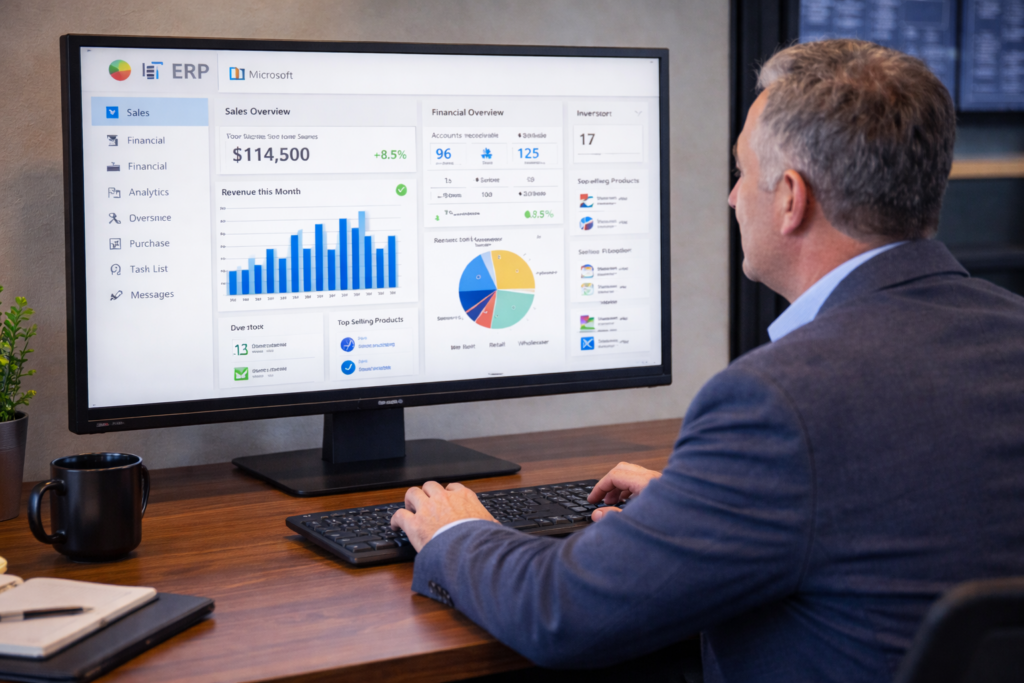
QuickBooks is where a lot of oilfield service companies start. It is affordable, familiar, and gets the job done when the business is small enough that a straightforward accounting tool covers most of what you need.
The problem is that oilfield service companies do not stay small. Jobs multiply. Crews expand. Equipment fleets grow. Service lines diversify. And at some point, the system that handled accounting for a five-person operation starts showing serious strain under the weight of a twenty, fifty, or hundred-person business running multiple lines of service across several job sites simultaneously.
That moment, when QuickBooks stops being a solution and starts being a constraint, is the moment the conversation about Microsoft Dynamics 365 Business Central with ofsERP® becomes worth having.
What QuickBooks Does Well for Early-Stage Oilfield Companies
It is worth being clear about this. QuickBooks is genuinely useful for oilfield service companies in their early stages, and the companies that start with it are not making a mistake.
For a small operation focused primarily on invoicing customers, paying vendors, tracking expenses, and producing basic financial reports, QuickBooks handles those tasks reliably and at a price point that makes sense for a business still finding its footing.
The limitations are not apparent immediately. They emerge gradually as the business grows and the gap between what QuickBooks was designed to do and what the business actually needs widens to the point where it can no longer be bridged by workarounds.
The Signs You Have Outgrown QuickBooks
Most oilfield service companies do not make the decision to move off QuickBooks because of a single breaking point. They make it because a pattern of limitations has been accumulating long enough that the cost of staying has become greater than the cost of changing.
Your Financial Data Lives in Too Many Places
QuickBooks handles accounting. It does not handle field ticketing, equipment tracking, rental order management, or job costing in any meaningful way for oilfield operations. As a result, oilfield companies running QuickBooks inevitably build a surrounding ecosystem of spreadsheets, separate field service apps, equipment tracking tools, and manual processes to cover the gaps.
The more that ecosystem grows, the more time your team spends moving data between systems, reconciling discrepancies, and managing integrations that were never designed to work together. That overhead compounds as job volume increases, and the administrative burden of holding the patchwork together starts consuming resources that should be going toward the operation itself.
Job Costing Is Impossible to Do Accurately
QuickBooks offers basic job costing functionality, but for oilfield service companies managing labor, materials, equipment usage, and overhead across multiple simultaneous jobs at different locations, that basic functionality falls well short of what is needed.
When you cannot accurately track what each job actually costs in real time, you cannot know which jobs are profitable and which are quietly eroding your margin. Pricing decisions get made on incomplete information. Underperforming jobs do not get identified until month-end reporting, when the opportunity to address them has already passed.
The impact on revenue growth is direct. Companies that cannot see their job-level profitability are making growth decisions based on aggregate financials that may look healthy while individual jobs underperform.
Equipment Management Is Handled Outside the System
QuickBooks has no meaningful equipment asset management capability. For oilfield service companies whose fleet is their primary revenue-generating asset, that gap is significant.
Equipment location, availability, utilization, maintenance history, and rental status all have to be managed in separate tools or spreadsheets. The result is the visibility problem that oilfield equipment asset management articles consistently identify as one of the most costly operational gaps in the industry: you do not know where your equipment is, whether it is available, or whether it is being utilized at a rate that justifies its cost on the balance sheet.
Billing Delays Are Becoming a Cash Flow Problem
In QuickBooks, the billing process depends on information that has to come from somewhere else. Field tickets have to be collected, data has to be entered manually, and the gap between job completion and invoice delivery grows with every step that requires human intervention.
For oilfield service companies trying to improve cash flow, that billing lag is one of the most direct contributors to receivables buildup. The proof and formulas behind billing efficiency make clear how significantly even modest reductions in billing cycle time translate into measurable cash flow improvement.
Reporting Does Not Give You What You Actually Need
QuickBooks produces standard financial reports. It does not produce the operational reporting that oilfield service companies need to run their business effectively: equipment utilization by asset, job profitability by service line, billing cycle performance, field ticket status across active jobs, or revenue by crew and location.
Getting those insights from QuickBooks requires exporting data, building reports in Excel, and spending time on analysis that should be available within the system itself. As the business grows, that reporting gap becomes a decision-making gap. Leadership is operating on incomplete information because the system cannot surface what they actually need to see.
The System Cannot Scale With Your Operation
QuickBooks was built for small business accounting. It was not built to support a growing oilfield service company managing hundreds of jobs, a large equipment fleet, multiple service lines, and a team that spans the field and the office.
As your operation grows, the limitations of QuickBooks do not just persist. They compound. More jobs mean more manual data entry. More equipment means more spreadsheets. More service lines mean more reconciliation. The administrative overhead required to keep QuickBooks functional at scale grows faster than the revenue that is supposed to be supporting it.
What Business Central With ofsERP® Does Differently
Microsoft Dynamics 365 Business Central with ofsERP® is not just a bigger version of QuickBooks. It is a fundamentally different approach to running an oilfield service business.
Everything in One Connected System
Rather than a core accounting tool surrounded by disconnected workarounds, Business Central with ofsERP® is a single environment where field operations, equipment management, billing, inventory, and financials all share the same data in real time.
Field tickets submitted by a crew in the field flow directly into invoicing without manual re-entry. Equipment usage captured on a job site flows directly into job costing. Rental orders, service orders, repair orders, and sale orders all run through the same system with distinct order types that reflect how oilfield companies actually operate. There is no ecosystem of separate tools to manage and no reconciliation process between systems that were never designed to work together.
Real-Time Job Costing That Protects Margin
ofsERP® connects labor, materials, equipment usage, and overhead to individual jobs as they happen. Your team can see what each job is actually costing in real time, not at month end when the numbers have already been locked in.
That visibility directly supports better pricing decisions, earlier identification of margin erosion, and more informed conversations with customers about scope changes before they affect profitability. For oilfield companies focused on cost reduction, real-time job costing is one of the most effective tools available.
Equipment Management Built Into the Platform
Every piece of equipment in your fleet has a complete record in ofsERP®, covering its full deployment history, maintenance log, repair records, utilization data, and current status. Scheduling is based on real availability information rather than phone calls. Maintenance is preventive rather than reactive. Fleet decisions are based on utilization data rather than intuition.
That level of equipment visibility is simply not possible in QuickBooks, and it makes a measurable difference in how efficiently your fleet generates revenue.
Billing That Keeps Pace With Operations
Because paperless field ticketing connects directly to invoicing in ofsERP®, the gap between job completion and invoice delivery shrinks dramatically. Billing keeps pace with operations rather than lagging behind them, which means receivables build up more slowly and cash flow reflects your actual job activity rather than a delayed version of it.
Reporting That Surfaces What You Actually Need
Business Central with ofsERP® produces operational and financial reporting that reflects how oilfield service companies think about their business. Equipment utilization, job profitability, billing cycle performance, crew productivity, and financial summaries are all available within the system without requiring manual exports or external analysis tools.
Microsoft Copilot, built into Business Central, extends that reporting capability further by allowing your team to ask questions in plain language and receive immediate answers from live operational data. The Microsoft Copilot in Business Central overview explains how this AI capability works in practice.
A Platform That Scales Without Friction
ofsERP® currently supports oilfield service companies with 5 to 400 users. Adding users, expanding service lines, and growing job volume does not require a system change or a significant increase in administrative overhead. The platform scales with your business because it was built for businesses at the scale your operation is heading toward, not just the scale it is at today.
The Migration From QuickBooks to Business Central
Moving from QuickBooks to Business Central is a significant operational transition, and it is worth approaching it with the same seriousness as any major business decision.
The good news is that CBSi has guided oilfield service companies through this transition many times. The migrating to Business Central guide covers the key steps, common challenges, and what a well-managed migration looks like in practice. CBSi’s approach starts with a thorough assessment of your current data and workflows before any migration work begins, which means the system you go live on is configured correctly from day one rather than requiring significant adjustment after the fact.
CBSi brings over 17 years of oilfield ERP implementation experience and more than 30 years of combined expertise in Microsoft Dynamics NAV and Business Central to every migration it manages. That depth of experience reduces the risk that comes with any major system transition and ensures the new platform is built around how your oilfield operation actually works rather than a generic business template. Learn more about why oilfield companies choose CBSi and explore the full range of ERP services CBSi provides from assessment through go-live and beyond.
QuickBooks vs Business Central Oilfield
The honest answer is that most oilfield service companies wait longer than they should. The limitations of QuickBooks build gradually, and because each individual workaround seems manageable in isolation, the cumulative cost of staying on an inadequate system does not always feel urgent until it becomes impossible to ignore.
The right time to evaluate Business Central with ofsERP® is before the limitations of your current system start actively constraining your growth, not after they have already cost you jobs, margin, or customers.
If any of the patterns described in this article feel familiar, that is a signal worth paying attention to sooner rather than later. The ofsERP® FAQ is a useful starting point for understanding how the platform addresses the specific operational challenges that QuickBooks cannot handle for oilfield service companies.
Ready to Take Your Oilfield Business to the Next Level?
The key is to start with what matters most to your business today, apply it consistently, and build from there. If you are ready to take your oilfield business to the next level, call 800-455-5915 or schedule a call!