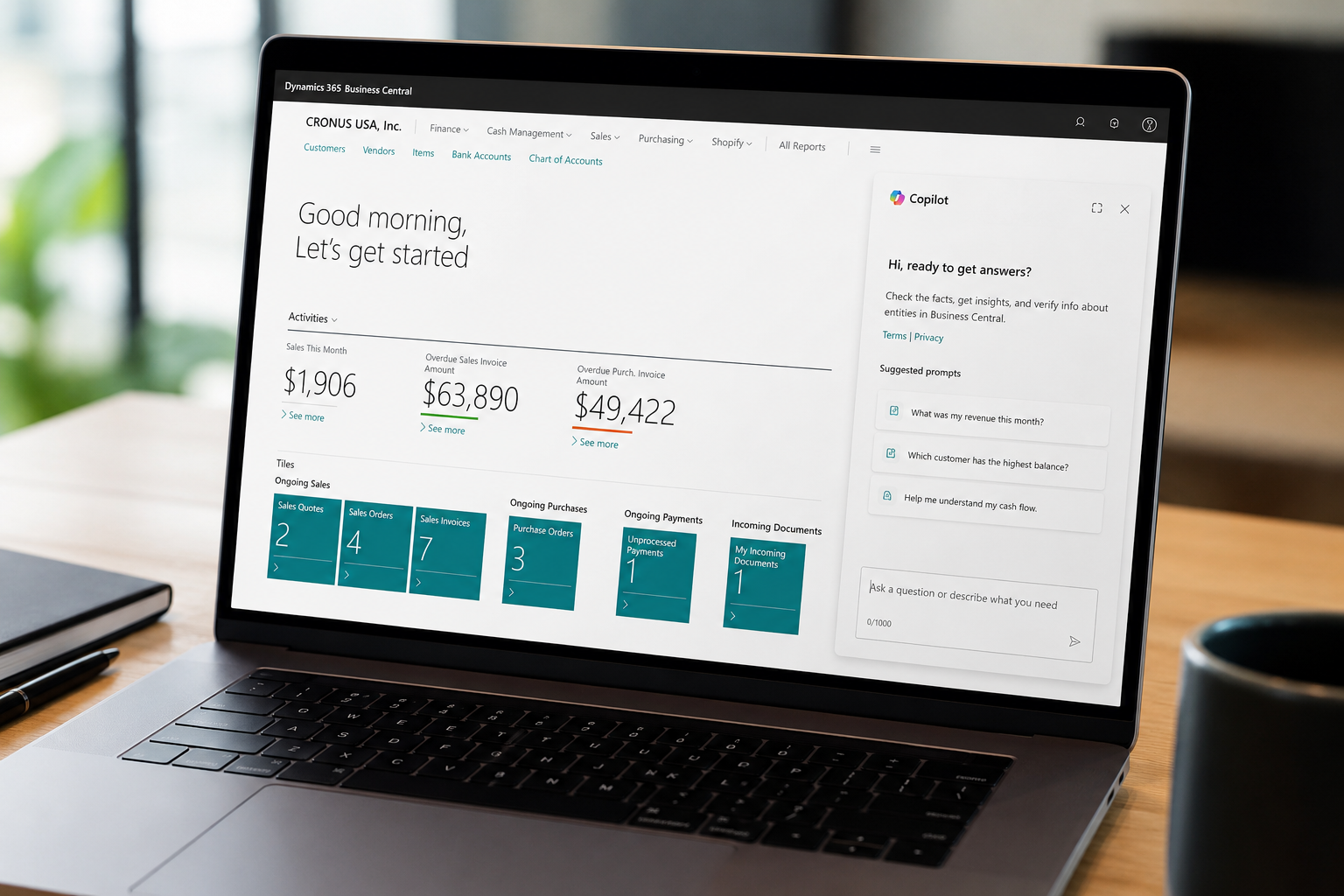
What is Microsoft Copilot in Business Central?

If you’re running a business today, you’re likely dealing with a constant flow of financial data, operational updates, and reporting requirements. The challenge isn’t having access to information — it’s how quickly you can turn that information into action.

That’s where microsoft copilot business central, built into Microsoft Dynamics 365 Business Central, starts to make a measurable difference.

Instead of spending hours entering data, navigating the system, or pulling reports, Copilot helps you move faster, reduce manual effort, and get to the answers you need without unnecessary steps.

What Microsoft Copilot Actually Does in Business Central

At a practical level, microsoft copilot business central works as an AI assistant inside your ERP system.

Rather than relying on manual navigation or specialized knowledge of the system, you can interact with your data more directly. You can ask questions, generate outputs, and receive suggestions based on real-time information.

This is part of the broader shift toward microsoft ai copilot erp, where AI is embedded into business applications to support how work gets done — not disrupt it.

You’re still in control of your processes. Copilot simply removes friction from them.

Where Businesses Typically Start to Slow Down

Most businesses don’t feel inefficiencies all at once. It builds gradually.

As your company grows, the same processes that once worked start taking longer, requiring more effort, and introducing more room for error.

You may start to notice it in areas like data entry, reporting, and internal workflows.

Data Entry and Processing Delays

As transaction volume increases, so does the workload. Entering invoices, updating records, and managing transactions begins to take up more time than expected.

What used to be a simple process can turn into a backlog.

Delayed Access to Insights

Even when your data is accurate, getting answers isn’t always immediate.

You may need to run reports, filter information, and verify results before making a decision. That delay can impact how quickly you respond to opportunities or issues.

Ongoing Corrections and Rework

Manual processes leave room for inconsistencies.

Over time, small errors lead to additional work — whether it’s fixing entries, reconciling discrepancies, or addressing delays caused by inaccurate information.

How Copilot Improves Day-to-Day Operations

This is where business central copilot begins to stand out.

Instead of adding more tools or layers, it works within your existing system to simplify how tasks are completed.

You’re no longer spending most of your time preparing data. You’re spending more time actually using it.

The copilot features dynamics 365 are designed to support the work your team is already doing, including:

  • Asking questions in plain language and getting immediate, data-driven answers
  • Generating content like product descriptions or summaries without starting from scratch
  • Receiving suggestions during data entry to reduce errors and improve consistency
  • Viewing financial summaries without needing to build detailed reports manually

These may seem like small improvements individually, but together they create a more efficient workflow across your entire operation.

A Scenario That Reflects What Many Businesses Experience

Let’s say you’re reviewing your financial performance at the end of the month.

In a typical process, this involves pulling multiple reports, checking numbers across departments, and making sure everything aligns. It’s time-consuming and often requires input from several people.

With Copilot in place, that process becomes more streamlined.

Instead of starting from scratch, you request a financial summary directly within the system. Copilot gathers the relevant data and presents it in a structured way, highlighting key figures and trends.

You still review and validate the information, but instead of spending hours collecting it, you’re focusing on understanding it.

That shift alone can significantly improve how quickly decisions are made.

Proving the Operational Impact

Let’s take a closer look at how small time savings can translate into measurable results.

In many businesses, tasks like reporting, data entry, and reconciliation can take several hours per week per employee. When these processes are improved — even slightly — the cumulative impact becomes significant.

For example, consider a team that reduces manual processing time by just 10 hours per week across departments.

Over the course of a year, that equates to more than 500 hours of regained productivity.

Now apply that time toward:

  • Faster financial reviews
  • More responsive customer service
  • Improved operational planning

The result is not just saved time — it’s improved performance across the business.

This is the same principle seen across ai in business central: reducing the time it takes to complete routine tasks leads to more capacity for higher-value work.

A Simple Way to Think About ROI

You don’t need a complex formula to understand the value.

If your team can complete tasks faster without sacrificing accuracy, you effectively increase output without increasing headcount.

Even modest improvements in efficiency can lead to:

  • Lower operational costs
  • Faster turnaround times
  • Better use of internal resources

Over time, these gains compound.

And unlike major system overhauls, this type of improvement happens within the system you’re already using.

The Bigger Shift Toward AI in ERP

What you’re seeing with Copilot is part of a broader transition.

ERP systems are no longer just tools for storing data. They are becoming systems that actively help you interpret and act on that data.

With microsoft ai copilot erp, the goal is simple: reduce the gap between information and action.

Instead of spending time navigating the system, your team can focus on making decisions and moving the business forward.

Getting More Out of Business Central

If you’re already using Microsoft Dynamics 365 Business Central, Copilot isn’t about replacing what you have — it’s about getting more value from it.

When paired with the right implementation strategy and extensions, such as industry-specific solutions like ofsERP, the impact can be even more noticeable.

You’re not just improving individual tasks, you’re improving how your entire system supports your business.

For a deeper look at how Microsoft positions AI within its ecosystem, you can also explore Microsoft Copilot and its broader capabilities across business applications.

Start Consolidating Your Eco System

At the end of the day, microsoft copilot business central is not about adding another feature.

It’s about making your ERP system easier to use, more efficient, and better aligned with how your business operates today.

If you’re starting to feel the strain of manual processes, delayed insights, or increasing complexity, this is one of those changes that can make a real difference—without requiring a complete shift in how your business runs.

And if you’re looking at ways to improve efficiency, reduce operational bottlenecks, and make better use of your data, this is a conversation worth having sooner rather than later.

The key is to start with what matters most to your business today, apply it consistently, and build from there. If you are ready to take your oilfield business to the next level, call 800-455-5915 or schedule a call!


How Oilfield Companies Improve Cash Flow Fast

Cash flow is the lifeblood of any oilfield service company — and it’s one of the first things that suffers when your operations and your back office aren’t working in sync.

You can have a full crew deployed, equipment running, and jobs completing on schedule — and still find yourself waiting on payments, chasing down billing discrepancies, or realizing that last month’s invoices haven’t gone out yet. The work is getting done. The money just isn’t following as quickly as it should.

That gap between field activity and financial reality is where most oilfield cash flow problems actually start.

The Real Reason Cash Flow Breaks Down in Oilfield

It’s rarely one big problem. It’s a series of smaller delays that stack up across your operation — each one adding a day here, a week there, until your billing cycle is running far behind your actual job schedule.

Field Tickets That Don’t Move Fast Enough

In many oilfield service companies, field tickets are still being handwritten, photographed, emailed, or physically dropped off at the office before they can be processed. By the time that information reaches accounting, days have already passed.

And if there’s any missing information — a signature, a service code, a piece of equipment not logged correctly — the ticket gets held up further while someone tracks down the details.

Every day a field ticket sits unprocessed is a day your invoice hasn’t gone out. And every invoice that hasn’t gone out is money you’ve already earned but can’t collect.

Manual Data Entry Between Systems

Most oilfield companies are running more than one system. Field service data lives in one place, equipment records in another, and accounting somewhere else entirely. Getting information from the field into an invoice requires someone to manually re-enter it — and that process introduces both delay and the risk of error.

When numbers don’t match across systems, reconciliation takes over. Instead of billing, your team is spending time verifying, correcting, and re-entering data that should have flowed automatically.

Approval Bottlenecks

Even when field data makes it to the office, it often has to pass through multiple approval steps before an invoice can go out. If the right person isn’t available, or if the data doesn’t match what was quoted, the invoice waits.

In a high-volume oilfield operation, these bottlenecks don’t just affect one job — they compound across dozens of open tickets at the same time.

Disputes That Slow Down Collections

When invoices finally do go out, inaccurate billing creates another problem downstream. A customer who receives an invoice that doesn’t match their records will dispute it — and disputed invoices don’t get paid until the issue is resolved.

Those disputes trace back to the same root cause: disconnected data between what happened in the field and what got billed.

How ofsERP® Closes the Gap Between Field and Finance

This is exactly the problem ofsERP®, built on Microsoft Dynamics 365 Business Central, was designed to solve.

Rather than patching together separate tools for field service, equipment tracking, and accounting, ofsERP® runs all of it in one unified system. Field data and financial data share the same environment — which means the delay between job completion and invoice generation is dramatically reduced.

Field Tickets Flow Directly Into Billing

With ofsERP®, field crews capture time, materials, equipment usage, photos, and signatures in real time. That information flows directly into the billing process without requiring manual re-entry or transfer between systems.

When a job is completed, the data is already where it needs to be. Your billing team isn’t waiting on paperwork — they’re working from accurate, real-time information that’s ready to invoice.

One System for Sales, Service, Rental, and Repair

One of the reasons ofsERP® works so well for oilfield companies is how it handles different order types within a single platform.

Rather than using Business Central’s native Service Management module — which was built for a different use case and requires a Premium license — ofsERP® uses Business Central’s existing Sales Order tables with distinct order types for Sale, Service, Rental, and Repair orders. Every line of business runs through the same system, which means your financial picture is always complete and your billing team is never working from partial information.

Equipment Utilization Visibility That Supports Revenue

Cash flow isn’t just about billing faster — it’s also about making sure your assets are generating revenue consistently.

When equipment location, availability, and usage are tracked in real time within ofsERP®, your team can see exactly which assets are deployed, which are sitting idle, and where utilization can be improved. That visibility directly supports better scheduling decisions and reduces the revenue lost to underutilized equipment.

Accurate Invoices That Get Paid Faster

Because ofsERP® connects field data directly to invoicing, the information on your invoices matches what actually happened on the job. That accuracy reduces disputes, speeds up customer approval, and shortens the time between invoice delivery and payment.

For oilfield service companies running high job volumes, even a modest reduction in the average days to payment can have a significant impact on cash position.

The Compounding Effect of Faster Billing

It’s worth stepping back to think about what faster billing actually means at scale.

If your company is running 50 jobs a week and the average delay between job completion and invoice delivery is five days, you have roughly 250 job-days of unbilled work sitting in your pipeline at any given time. Tighten that cycle by even two or three days and the impact on your receivables balance is immediate.

Now factor in reduced disputes, fewer reconciliation hours, and better equipment utilization — and the compounding effect becomes significant. You’re not just collecting faster. You’re also spending less time on the back-office work that was slowing collections down in the first place.

Built for Oilfield. Built to Scale.

CBSi brings over 17 years of oilfield ERP implementation experience and more than 30 years of combined expertise in Microsoft Dynamics NAV and Business Central. That depth of industry knowledge means ofsERP® wasn’t designed by adapting a generic platform — it was built from the ground up around how oilfield service companies actually operate.

ofsERP® is currently used by companies with 5 to 400 users. Whether you’re a growing oilfield service provider or a multi-division operation managing complex financial workflows, the platform scales with you — without requiring a system change as your business evolves.

Because ofsERP® is built as an extension of Business Central rather than a modification of it, your system continues to receive Microsoft updates without interruption. You get the reliability of a Microsoft-certified platform with the oilfield-specific functionality your operation actually needs.

A Different Approach to Cash Flow

Most cash flow problems in oilfield aren’t solved by chasing customers harder. They’re solved by fixing the gaps between field operations and the back office — so invoices go out faster, disputes happen less often, and collections follow more predictably.

ofsERP® is built to close those gaps. If your current setup is adding days to your billing cycle, creating reconciliation work, or leaving equipment revenue on the table, that’s a conversation worth having now rather than later.

Ready to Take Your Oilfield Business to the Next Level?

The key is to start with what matters most to your business today, apply it consistently, and build from there. If you’re ready to take your oilfield business to the next level, call 800-455-5915 or schedule a call!

Revenue Growth Strategies for Oilfield Service Companies

Growing an oilfield service company isn’t just about winning more jobs. It’s about building the operational foundation that lets you handle more work — without proportionally increasing your costs, your headcount, or your risk.

That distinction matters more than most people realize. A lot of oilfield companies win the work and then struggle to deliver it profitably. The jobs are there. The revenue potential is real. But the systems holding everything together weren’t built for the scale the business is trying to reach.

If your growth keeps running into the same operational ceiling, the problem usually isn’t your sales pipeline. It’s what’s happening behind it.

Why Growth Stalls in Oilfield Service Companies

Oilfield service companies face a unique set of revenue growth strategies’ challenges — ones that don’t always show up clearly until you’re already in the middle of them.

Scaling Headcount Faster Than Revenue

When your processes are manual, growth requires more people. More jobs mean more field tickets to process, more equipment to track, more invoices to generate, and more discrepancies to reconcile. If every increase in job volume requires a proportional increase in back-office staff, your margins shrink as your revenue grows.

That’s not a growth problem. That’s a systems problem wearing a growth problem’s clothes.

Losing Visibility as Operations Expand

A small oilfield service company can often get by on spreadsheets, phone calls, and institutional knowledge. As the business grows — more crews, more equipment, more job sites — that informal system breaks down.

Decisions start getting made on incomplete information. Equipment gets double-booked or sits idle because nobody has a clear picture of availability. Job costing becomes harder to track across multiple active projects. Revenue gets left on the table not because the work isn’t there, but because the operational visibility isn’t.

Billing That Can’t Keep Up with Job Volume

As job volume increases, so does the complexity of your billing cycle. More field tickets, more order types, more customers with different billing requirements — and the same back-office process trying to handle all of it.

When billing can’t keep pace with operations, receivables build up, cash flow tightens, and the business that looks profitable on paper starts feeling constrained in practice.

Winning New Business Without the Infrastructure to Support It

Landing a larger contract or expanding into a new service line is a growth milestone. But if your systems can’t support the added complexity — different order types, additional equipment categories, more detailed reporting — that growth creates operational strain instead of opportunity.

The companies that scale successfully aren’t just winning more work. They’re building the infrastructure to deliver it efficiently before the demand arrives.

How ofsERP® Supports Sustainable Revenue Growth

This is where ofsERP®, built on Microsoft Dynamics 365 Business Central, changes the equation for oilfield service companies.

Rather than adding more tools, more integrations, or more manual processes as your business grows, ofsERP® gives you a single platform that scales with your operation — handling increasing job volume, complexity, and reporting requirements without requiring a system change every time your business reaches a new level.

Grow Without Growing Your Back Office

One of the most direct ways ofsERP® supports revenue growth is by reducing the back-office overhead that typically scales with job volume.

Because field ticket data flows directly into billing without manual re-entry, your accounting team can process a higher volume of jobs without adding headcount. The time previously spent transferring data between systems, reconciling discrepancies, and chasing down missing information gets redirected toward work that actually moves the business forward.

For oilfield service companies looking to improve margin alongside revenue, that efficiency gain is significant. You’re doing more with the team you already have.

Real-Time Visibility Across Every Line of Business

ofsERP® handles Sale, Service, Rental, and Repair order types within a single system — which means every line of your business is visible in one place, in real time.

That visibility directly supports better business decisions. You can see which service lines are most profitable, where equipment utilization is strongest, which job types are generating the most revenue, and where operational gaps are costing you margin. Instead of pulling reports from multiple systems and reconciling them manually, your leadership team is working from a single, accurate picture of the business.

When you can see your operation clearly, you can grow it intentionally — investing in the areas with the highest return and addressing the gaps before they become constraints.

Equipment Utilization as a Revenue Lever

For oilfield service companies, equipment is one of the largest assets on the balance sheet — and one of the most underutilized revenue levers in the business.

When equipment location, availability, and utilization are tracked in real time within ofsERP®, your team can identify idle assets, optimize scheduling, and ensure your equipment is generating revenue consistently rather than sitting between jobs. Even modest improvements in utilization across a fleet can translate into meaningful revenue gains without adding a single new piece of equipment.

That’s growth that comes from working smarter with what you already own.

Job Costing That Protects Margin as You Scale

Winning more jobs only drives revenue growth if those jobs are priced and managed profitably. As oilfield operations grow more complex — more service lines, more equipment categories, larger crews — job costing becomes harder to track accurately.

ofsERP® connects labor, materials, equipment usage, and overhead to individual jobs in real time, giving your team accurate cost visibility throughout the life of each project. That visibility lets you catch margin erosion early, adjust pricing where needed, and make sure the work you’re winning is actually contributing to the bottom line.

Accurate Reporting That Supports Strategic Decisions

Revenue growth requires making the right decisions at the right time — which means having accurate, timely data when those decisions need to be made.

Because ofsERP® runs on Microsoft Dynamics 365 Business Central, your financial reporting, operational data, and job performance metrics are all accessible within the same platform. No pulling numbers from separate systems. No waiting for end-of-month reports to understand where the business stands.

When leadership has real-time access to accurate data, growth decisions are based on facts rather than estimates — and that clarity reduces the risk that comes with scaling.

The Infrastructure Behind Sustainable Growth

There’s a pattern that shows up consistently in oilfield service companies that grow successfully over time.

They build their operational infrastructure ahead of demand rather than in response to it. They invest in systems that reduce manual work before that work becomes a bottleneck. They create visibility across their operation before the complexity of growth makes it hard to see clearly.

ofsERP® is built to be that infrastructure. CBSi brings over 17 years of oilfield ERP implementation experience and more than 30 years of combined expertise in Microsoft Dynamics NAV and Business Central — which means the platform was built with a deep understanding of how oilfield service companies actually grow, where they run into trouble, and what it takes to scale without losing control of your operation.

ofsERP® currently supports companies with 5 to 400 users. Whether you’re in an early growth phase or managing a large multi-division operation, the platform scales with your business — and because it’s built as an extension of Business Central rather than a modification of it, you continue receiving Microsoft updates without interruption as your needs evolve.

Growth Is a Systems Problem as Much as a Sales Problem

If your oilfield service company is ready to grow — more jobs, more service lines, more revenue — the question worth asking is whether your current systems can support that growth without creating new problems in the process.

The companies that grow fastest aren’t always the ones with the biggest sales teams. They’re the ones that have built the operational foundation to deliver more work, more efficiently, with better visibility into what’s actually driving their results.

That foundation is what ofsERP® is built to provide.

Ready to Take Your Oilfield Business to the Next Level?

The key is to start with what matters most to your business today, apply it consistently, and build from there. If you’re ready to take your oilfield business to the next level, call 800-455-5915 or schedule a call!

What Is ofsERP® — And Why Oilfield Service Companies Are Switching to It

If you’re running an oilfield service company today, you’re probably managing more moving parts than your current software was ever designed to handle.

Field tickets that don’t connect to invoicing. Equipment tracked on spreadsheets. Rental orders living in one system, financials in another. The data exists — but getting it to work together is another problem entirely.

What is ofsERP®? That’s where ofsERP®, built on Microsoft Dynamics 365 Business Central, starts to make a measurable difference.

What ofsERP® Actually Does

At a practical level, ofsERP® is an ERP built specifically for oilfield service companies — not adapted from a generic platform, but purpose-built for the way oilfield operations actually work.

It replaces the disconnected tools most oilfield companies are piecing together — field service apps, rental tracking, equipment logs, billing software — with one unified system running on Microsoft Business Central.

Field tickets, equipment asset management, rental orders, job costing, invoicing, and financials all operate in the same environment. No separate integration required.

Where Oilfield Companies Start to Feel the Strain

The inefficiencies rarely show up all at once. They build over time, and usually in the same places.

Billing Delays After Job Completion

When field data doesn’t connect directly to invoicing, there’s always a lag. Someone has to manually transfer information, verify it, and push it through. The gap between job completion and invoice delivery costs real money.

Equipment Visibility Gaps

Knowing where your equipment is, whether it’s available, and how well it’s being utilized requires real-time data. Without it, utilization suffers and scheduling becomes guesswork.

Multiple Systems That Don’t Talk to Each Other

When field crews, the office team, and accounting are working from different tools, errors compound. Reconciling those discrepancies takes time that could be spent elsewhere.

How ofsERP® Addresses These Gaps

This is where the design of ofsERP® stands out from generic ERP solutions.

Most field service ERP platforms are built around servicing a customer’s equipment. ofsERP® is built around a different reality — oilfield service companies use their own equipment to provide services at a job site or well. The focus is on tracking, renting, and maintaining their own assets, not a customer’s.

Rather than using Business Central’s native Service Management module — which requires a Premium license and was designed for a different use case — ofsERP® uses Business Central’s existing Sales Order tables with different order types for Sale, Service, Rental, and Repair orders. This approach keeps things simpler, requires only an Essentials BC license, and delivers more flexibility for oilfield workflows.

Field crews can capture time, materials, equipment usage, photos, and signatures in real time. That data flows directly to accounting and project management — eliminating the gap between what happens in the field and what gets billed.

The Operational Impact

Consider what happens when billing cycles tighten.

When field ticket data connects directly to invoicing, the delay between job completion and invoice delivery shrinks significantly. For oilfield service companies running high job volumes, that compression in the billing cycle directly improves cash flow.

The same applies to equipment utilization. When location, availability, and usage data are visible in one system, scheduling becomes more precise and underutilized assets are easier to identify and redeploy.

These aren’t abstract efficiency gains. They show up in real numbers — faster invoicing, better utilization rates, fewer hours spent reconciling data across systems.

Built for Companies at Any Stage of Growth

ofsERP® is currently used by companies with 5 to 400 users.

The platform is designed to scale as your operation grows — whether you’re managing a few crews or running a multi-division oilfield service company with complex financial workflows. Because it’s built as an extension of Business Central rather than a modification of it, it receives Microsoft updates without interruption and doesn’t require a platform change as your needs evolve.

CBSi brings over 17 years of oilfield ERP implementation experience and more than 30 years of combined expertise in Microsoft Dynamics NAV and Business Central. That background matters when you’re setting up a system that has to work correctly from day one.

A Different Approach to ERP for Oilfield

Most ERP implementations feel like fitting your business into someone else’s template.

ofsERP® was designed the other way around — starting from how oilfield service companies actually operate and building the system to match. The result is a platform that handles the full scope of oilfield service operations without the workarounds, patchwork integrations, or licensing overhead that comes with trying to adapt a generic solution.

If your current setup is creating more friction than it’s removing, that’s worth looking at sooner rather than later. The right ERP doesn’t just store your data — it helps you act on it faster, bill more accurately, and run a tighter operation across every line of business.

Ready to Take Your Oilfield Business to the Next Level?

The key is to start with what matters most to your business today, apply it consistently, and build from there. If you’re ready to take your oilfield business to the next level, call 800-455-5915 or schedule a call!

Posted in ERP

AI in Inventory Management: How ofsERP® and Business Central Are Changing the Game for Oilfield Service Companies

AI in Inventory management has always been one of the more demanding operational challenges for oilfield service companies. The sheer volume of parts, equipment, consumables, and materials moving across job sites, warehouses, and service locations creates complexity that manual processes and basic software were never built to handle well.

The result, for most oilfield companies, is a familiar set of problems. Stockouts that delay jobs. Overstock that ties up capital. Parts ordered at the wrong time, in the wrong quantities, for the wrong location. And a back office spending significant time on inventory tasks that should be largely automatic.

Artificial intelligence is changing what is possible in inventory management, and Microsoft Dynamics 365 Business Central, combined with ofsERP®, is bringing those capabilities directly into the oilfield service environment.

Why Inventory Management Is Particularly Challenging in Oilfield

Before looking at how AI addresses these challenges, it is worth understanding why inventory management is so difficult for oilfield service companies specifically.

Inventory Spread Across Multiple Locations

Unlike a manufacturer with a single facility, oilfield service companies are managing inventory across job sites, service trucks, warehouses, and potentially multiple regional locations. Knowing what is available, where it is, and whether it is in usable condition requires visibility that most traditional inventory systems cannot provide in real time.

When that visibility is missing, purchasing decisions are made on incomplete information. Parts get ordered that are already sitting in a service truck. Critical consumables run out at a job site because nobody knew the stock was low. Equipment sits idle because a required component was not available when it was needed.

Demand That Is Difficult to Predict

Oilfield inventory demand is not steady or predictable in the way that manufacturing demand can be. Job schedules shift. New contracts bring unexpected material requirements. Equipment failures create urgent demand for parts that were not on anyone’s radar.

Traditional inventory management approaches, built around fixed reorder points and static par levels, struggle to keep pace with that variability. The result is either excess inventory that ties up working capital or insufficient stock that delays operations.

The Cost of Getting It Wrong

In oilfield operations, the cost of an inventory mistake is not just the cost of the missing part. It is the cost of the job delay, the crew standing by, the customer relationship affected, and the revenue recognition pushed back while the issue is resolved. Inventory errors in oilfield have a compounding effect that makes accurate management genuinely critical to operational performance.

How AI Changes What Is Possible in Inventory Management

Artificial intelligence addresses inventory management in a fundamentally different way than traditional rule-based systems. Rather than applying fixed logic, AI analyzes patterns across your historical data, identifies relationships between variables, and generates recommendations that improve over time as more data becomes available.

For oilfield service companies, that shift has practical implications across several areas of inventory management.

Demand Forecasting That Accounts for Real Operational Patterns

AI-driven demand forecasting in Business Central analyzes historical usage data, job schedules, seasonal patterns, and operational trends to generate more accurate predictions of future inventory needs. Rather than relying on static reorder points that were set based on general assumptions, the system continuously refines its understanding of what your operation actually consumes and when.

For oilfield companies where demand is tied to job activity rather than a steady production cycle, that dynamic forecasting capability is significantly more accurate than traditional approaches. The system learns from your actual operational patterns rather than applying generic inventory logic that was not designed for oilfield workflows.

Automated Reorder Recommendations That Reduce Stockouts and Overstock

Rather than waiting for inventory to fall below a fixed threshold before triggering a reorder, AI-powered inventory management in Business Central generates proactive reorder recommendations based on predicted demand, current stock levels, supplier lead times, and job schedules already in the system.

That proactive approach reduces both stockouts and overstock simultaneously. The system is not just reacting to inventory levels that have already fallen too low. It is anticipating what will be needed and when, based on a broader picture of operational activity than any manual review process could reliably maintain.

For oilfield service companies carrying a wide range of parts and consumables across multiple locations, that automation significantly reduces the time your team spends on manual inventory reviews while improving the accuracy of the purchasing decisions that result from them.

Real-Time Inventory Visibility Across All Locations

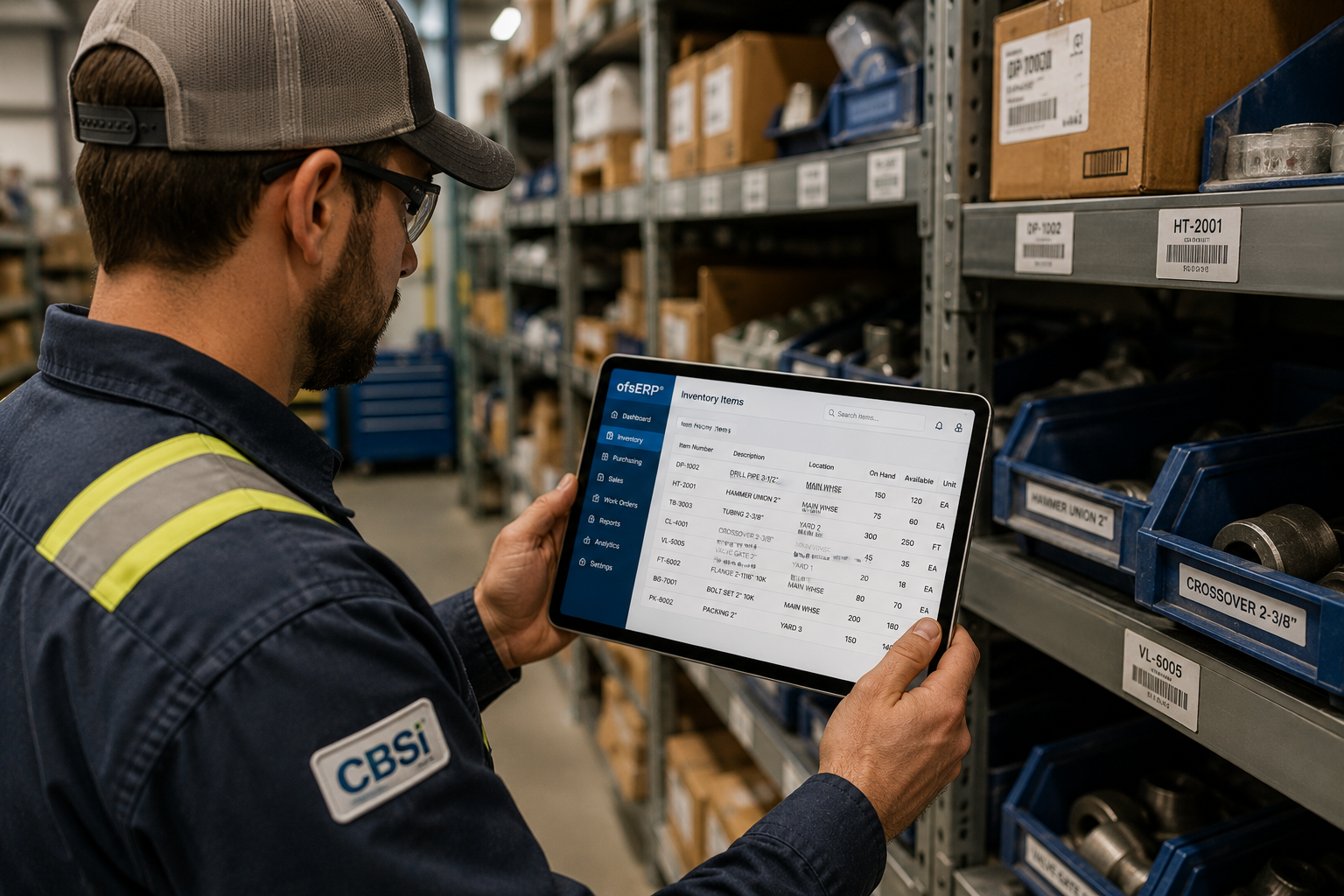
ofsERP® connects inventory data across job sites, service trucks, warehouses, and office locations in a single real-time view within Business Central. That visibility means purchasing decisions are based on what is actually available across the entire operation, not just what is in one location or what was recorded the last time someone manually updated a spreadsheet.

When a part is needed at a job site, the system can immediately show whether it is available at a nearby warehouse, on a service truck already in the area, or needs to be ordered. That real-time visibility reduces emergency purchasing, minimizes duplicate stock, and ensures that inventory is deployed where it is actually needed rather than accumulating in one location while another goes short.

AI-Assisted Anomaly Detection That Catches Problems Early

Business Central’s AI capabilities include anomaly detection that identifies unusual patterns in inventory data before they become operational problems. Consumption rates that are significantly higher than expected, inventory discrepancies between recorded and physical counts, and purchasing patterns that deviate from historical norms are all flagged for review automatically.

For oilfield service companies, that early warning capability has real value. Equipment that is consuming more parts than expected may indicate a maintenance issue that has not yet been formally identified. Inventory discrepancies may point to tracking gaps that are creating inaccurate purchasing decisions. Catching those patterns early reduces the downstream cost of addressing them.

Copilot Integration for Faster Inventory Insights

Microsoft Copilot, built into Business Central, extends AI capabilities into how your team interacts with inventory data on a daily basis. Rather than navigating reports and filtering data manually, your purchasing and operations team can ask questions in plain language and receive immediate, data-driven answers.

Which parts are running low across all locations? What is the current stock level of a specific item at each job site? Which inventory categories have the highest variance between forecasted and actual consumption this quarter? Those questions, which previously required manual report generation, can be answered directly within the system in seconds.

That accessibility does not replace the judgment of your experienced team. It removes the friction between having a question and getting an answer, so the people responsible for inventory decisions are spending their time on the decisions themselves rather than the data gathering that precedes them.

Why the Platform Underneath Inventory AI Matters

AI capabilities are only as useful as the data they have access to. An AI-powered inventory system that is working from incomplete, inaccurate, or siloed data will generate recommendations that reflect those limitations.

This is where Business Central with ofsERP® provides a meaningful advantage for oilfield service companies. Because ofsERP® unifies field operations, equipment management, job costing, and financials in a single environment, the data available to Business Central’s AI capabilities is complete and connected across the entire operation.

Inventory AI in Business Central is not working from a subset of your operational data. It is working from the full picture, including job schedules, equipment utilization, field consumption data captured in real time, and historical patterns across every location your business operates. That completeness is what allows the AI recommendations to be genuinely useful rather than directionally correct but operationally incomplete.

CBSi brings over 17 years of oilfield ERP implementation experience and more than 30 years of combined expertise in Microsoft Dynamics NAV and Business Central to every implementation. That experience means the platform is configured to capture the right data from day one, so the AI capabilities built into Business Central have the operational history they need to generate meaningful recommendations as quickly as possible after go-live.

You can learn more about how CBSi approaches ERP implementation and configuration for oilfield service companies, and explore the ofsERP® FAQ for detailed information on how the platform handles inventory management within the Business Central environment.

Inventory Management That Works as Hard as Your Operation Does

The oilfield service companies that manage inventory most effectively are not the ones with the largest purchasing teams or the most complex manual processes. They are the ones whose systems are doing the analytical work automatically, surfacing the right information at the right time, and allowing their team to act on accurate data rather than educated guesses.

Business Central with ofsERP® brings that capability to oilfield service companies of all sizes, from growing operations with 5 users to established multi-division companies with 400. The AI is built into the platform you are already running, not a separate tool that needs to be integrated and maintained alongside everything else.

If your current inventory management is creating delays, tying up capital, or requiring more manual effort than it should, that is a conversation worth having with CBSi before the next job cycle rather than after it.

Ready to Take Your Oilfield Business to the Next Level?

The key is to start with what matters most to your business today, apply it consistently, and build from there. If you are ready to take your oilfield business to the next level, call 800-455-5915 or schedule a call!

Posted in AI

Cloud ERP vs On-Premise ERP: Which Is Right for Oilfield Service Companies?

When oilfield service companies start evaluating ERP systems, one of the first decisions they face has nothing to do with features or functionality. It has to do with where the system lives and how it is managed.

Cloud ERP and on-premise ERP represent two fundamentally different approaches to running your business software. Both have real advantages. Both come with trade-offs. And for oilfield service companies specifically, the choice has implications that go beyond IT infrastructure and into how your operation runs day to day.

This is an honest comparison of both options, and a straightforward look at why most oilfield service companies today are moving toward cloud-based ERP.

What Is On-Premise ERP?

On-premise ERP means the software is installed and runs on servers that your company owns and manages, either at your own facility or through a third-party data center you control.

Your IT team is responsible for maintaining the hardware, managing security, applying updates, and ensuring the system stays operational. Everything lives inside your own infrastructure.

For many years, on-premise was the only option. Companies built their operations around it, and for some businesses in specific situations, it still makes sense today.

Where On-Premise Works

On-premise ERP can be a reasonable choice when a company has strict data sovereignty requirements that prevent information from being stored outside their own infrastructure. It can also work for organizations that have a large, experienced internal IT team already managing complex systems, or for businesses operating in locations where reliable internet connectivity is not consistently available.

In those specific circumstances, the control that on-premise provides has real value.

Where On-Premise Falls Short

Outside of those specific situations, on-premise ERP introduces costs and constraints that most growing oilfield service companies are not well positioned to manage.

Hardware is expensive to purchase, maintain, and eventually replace. Security is your team’s responsibility, which means your exposure to risk grows alongside your obligation to manage it. Updates and upgrades require internal resources to plan and execute, which often means companies fall behind on versions and miss improvements the software vendor has already built.

Scaling an on-premise system as your business grows typically means additional hardware investment and IT overhead. And if something goes wrong at the server level, recovery depends entirely on your internal capabilities and backup infrastructure.

For a business focused on running oilfield operations, managing all of that is a significant distraction from the actual work of the company.

What Is Cloud ERP?

Cloud ERP means the software runs on servers managed by the software vendor or a trusted hosting partner, and is accessed through the internet. Your team uses the system from any device, in any location, without needing to manage the underlying infrastructure.

Updates happen automatically. Security is managed at the platform level. Scaling is handled by the cloud infrastructure rather than your IT budget. And because the system is accessible from anywhere with an internet connection, your team in the field and your team in the office are working from the same data in real time.

Where Cloud ERP Wins for Oilfield

For oilfield service companies, the advantages of cloud ERP are directly aligned with how the business actually operates.

Field accessibility. Your crews are not in an office. They are at well sites, job locations, and remote facilities. Cloud ERP means field data can be captured in real time, from the field, and flow immediately into billing and operations without anyone having to physically return to the office or transfer information manually.

Lower total cost of ownership. Without the hardware investment, internal IT overhead, and ongoing maintenance costs associated with on-premise systems, cloud ERP typically delivers a lower total cost over time. You pay a predictable subscription rather than absorbing unpredictable capital and operational expenses.

Automatic updates. When the software vendor releases improvements, your system gets them without requiring internal planning, resources, or downtime. Your ERP stays current without additional effort on your part.

Scalability without capital investment. As your oilfield operation grows, adding users and capacity in a cloud environment does not require new hardware purchases. The infrastructure scales with your business at a fraction of the cost of expanding an on-premise system.

Business continuity and reliability. Cloud platforms maintained by enterprise-grade vendors like Microsoft operate with redundancy and disaster recovery built in. If something goes wrong at the infrastructure level, it is the vendor’s responsibility to resolve it, not yours.

Where Cloud ERP Has Limitations

Cloud ERP does depend on a reliable internet connection. For oilfield companies operating in very remote locations where connectivity is limited or inconsistent, this is a real consideration.

It is also worth noting that in a cloud environment, your data is stored on the vendor’s infrastructure rather than your own. For most businesses, the security standards maintained by enterprise cloud providers far exceed what they could achieve with internal infrastructure. But for companies with specific regulatory or contractual data requirements, this is worth evaluating carefully before making a decision.

How ofsERP® Approaches This Decision

ofsERP®, built on Microsoft Dynamics 365 Business Central, is designed to run in the cloud by default, and for good reason.

Microsoft’s cloud infrastructure is among the most secure, reliable, and widely trusted in the world. Business Central is a cloud-first platform, which means it receives continuous improvements, security updates, and new capabilities through Microsoft’s regular release cycles. Companies running ofsERP® on Business Central benefit from that investment without having to manage it themselves.

For oilfield service companies that have specific reasons to keep their system on-premise or prefer a hybrid approach, CBSi also offers hosting on Microsoft Azure. That means your data stays within a controlled, enterprise-grade environment while still giving your team cloud-level accessibility and CBSi’s management expertise handling the infrastructure.

This flexibility matters because not every oilfield company is in the same situation. CBSi’s approach is to match the deployment model to your actual business requirements rather than applying a one-size-fits-all recommendation.

The Real Question Is Not Cloud vs On-Premise

Most oilfield service companies that spend time comparing cloud and on-premise ERP eventually realize the deployment model is not the most important question. The more important questions are whether the system was built for oilfield operations, whether the implementation partner understands your industry, and whether the platform can support your business as it grows.

A cloud-based generic ERP still will not handle field tickets, equipment rental, and oilfield job costing the way your operation requires. And an on-premise system built for oilfield will still carry the infrastructure and maintenance burden that diverts resources from your core business.

The companies that get the most out of their ERP investment are the ones that start with the right platform for their industry and choose the deployment model that fits their operational reality, rather than making the deployment decision first and then trying to find software that fits around it.

ofsERP® is purpose-built for oilfield service companies and runs on the most trusted cloud infrastructure available. CBSi brings over 17 years of oilfield ERP implementation experience and more than 30 years of combined expertise in Microsoft Dynamics NAV and Business Central to every implementation it supports.

Whether you are evaluating cloud ERP for the first time, reconsidering an existing on-premise system, or trying to understand which approach makes the most sense for your specific operation, that conversation is worth having with people who understand both the technology and the industry it is serving.

You can learn more about why companies choose CBSi and explore the full range of ERP services CBSi offers, from assessment and implementation to training and ongoing support. The ofsERP® FAQ is also a useful resource if you have specific questions about how the platform handles oilfield workflows and deployment options.

Ready to Take Your Oilfield Business to the Next Level?

The key is to start with what matters most to your business today, apply it consistently, and build from there. If you are ready to take your oilfield business to the next level, call 800-455-5915 or schedule a call!
Posted in ERP

Migrating to Business Central: What Oilfield Service Companies Need to Know

At some point, most oilfield service companies reach a moment where their current system stops keeping up with the business. Reports take too long. Processes that used to work are creating bottlenecks. The software that made sense five years ago is now a constraint on growth rather than a foundation for it.

That moment is usually when the conversation about migrating to Microsoft Dynamics 365 Business Central begins.

Migration is the right move for a lot of oilfield companies. Business Central is a modern, cloud-first ERP platform with the flexibility to support complex oilfield operations, the reliability of Microsoft’s infrastructure behind it, and the scalability to grow alongside your business. But the path from your current system to a fully operational Business Central environment is not without its challenges.

Understanding those challenges before you start, and having the right partner guiding the process, is what separates a migration that delivers on its promise from one that creates more problems than it solves.

Why Oilfield Companies Move to Business Central

The decision to migrate rarely happens overnight. It builds gradually as the limitations of an existing system become harder to work around.

Outgrowing Legacy Systems

Many oilfield service companies are still running software that was built for a smaller, simpler version of the business. As operations expand, those systems require more manual workarounds, more staff to manage the same processes, and more time spent reconciling data across systems that were never designed to work together.

Legacy systems also tend to fall behind on security updates and vendor support. At a certain point, the cost of maintaining an aging system starts to exceed the cost of replacing it, and the risk of staying on unsupported software becomes a real operational concern.

The Limitations of Disconnected Tools

A common pattern in oilfield service companies is a patchwork of specialized tools, one for field ticketing, another for equipment tracking, a separate accounting platform, and various spreadsheets filling the gaps between them. Each tool does its job reasonably well in isolation, but the friction between them creates delays, errors, and a back office that spends more time moving data than using it.

Migrating to Business Central with ofsERP® consolidates those tools into a single environment where field operations, equipment management, and financials all share the same data in real time.

Scaling Without Adding Overhead

As job volume grows, manual processes require more people to manage them. Companies that want to grow revenue without proportionally growing their back-office headcount need a system that can handle increased complexity without increased manual effort. Business Central, configured correctly for oilfield operations, is built to support that kind of scale.

The Real Challenges of ERP Migration

Migration to Business Central is not simply a matter of moving data from one system to another. It is an operational transition that touches every part of your business, and the companies that underestimate that complexity are the ones that run into trouble.

Data Migration Is More Complex Than It Looks

Every ERP migration involves moving years of business data into a new system. Customers, vendors, inventory, equipment records, transaction history, open orders, and financial balances all have to be transferred accurately and completely.

The challenge is that data in legacy systems is rarely clean. There are duplicate records, outdated entries, inconsistent formats, and information structured in ways that do not map directly to Business Central’s data model. Migrating that data without a careful review and cleanup process means carrying legacy problems into a new system, where they then affect every report, invoice, and operational decision the system produces.

Workflow Redesign Takes Time and Expertise

Migration is not just a technical exercise. It is an opportunity to redesign how your business operates within a more capable system. But that redesign requires expertise in both the software and the industry.

Configuring Business Central to handle oilfield-specific workflows, order types, equipment management, and job costing correctly requires people who understand how oilfield service companies actually operate. A configuration that works for a generic business will not work for an oilfield company without significant additional work.

Managing Disruption During the Transition

The period between starting a migration and going live on the new system is one of the highest-risk phases in any ERP project. Business has to keep running while the new system is being built and tested. Data is being migrated while transactions are still occurring in the old system. Staff are learning a new platform while still responsible for their day-to-day work.

Without a structured transition plan, that period creates confusion, delays, and gaps in data that are difficult to recover from after go-live.

User Adoption Does Not Happen Automatically

Even a perfectly configured system underperforms if the people using it are not equipped to use it effectively. User adoption is one of the most consistently underestimated challenges in ERP migration.

When staff revert to old habits, work around the system, or use it inconsistently, data quality suffers and the operational improvements the migration was supposed to deliver fail to materialize. Getting adoption right requires training that is specific to how your team works, not generic software tutorials.

How CBSi Approaches Business Central Migration for Oilfield Companies

CBSi has been guiding oilfield service companies through ERP migrations for over 17 years, with more than 30 years of combined expertise in Microsoft Dynamics NAV and Business Central. That experience shapes every aspect of how CBSi manages the migration process.

Starting With a Structured Assessment

Before any migration work begins, CBSi conducts a thorough assessment of your current system, your data, and your operational workflows. That assessment identifies the gaps between where you are and where you need to be, surfaces data quality issues that need to be resolved before migration, and establishes a clear picture of how Business Central needs to be configured to support your specific operation.

Starting with that clarity reduces the risk of surprises during the migration and ensures that the configuration decisions made early in the process are aligned with how your business actually runs. You can learn more about CBSi’s ERP services and assessment process on their services page.

Data Cleanup as Part of the Process

CBSi treats data migration as an opportunity to start clean, not just move what exists. As part of the migration process, CBSi works with your team to identify outdated records, resolve duplicates, and ensure the data going into Business Central accurately reflects the current state of your business.

That upfront investment in data quality pays dividends immediately after go-live, when every report, invoice, and operational decision in the new system is based on accurate, complete information rather than inherited legacy problems.

ofsERP® Configuration Built Around Oilfield Workflows

For oilfield service companies, migrating to Business Central with ofsERP® means the system is configured around how oilfield operations actually work, not around a generic business template.

Field ticketing, equipment asset management, rental and repair order types, job costing, and real-time field data capture are all built into the platform from the start. The configuration reflects oilfield workflows because CBSi’s team understands those workflows from years of implementing them across companies of different sizes and service lines. The ofsERP® FAQ outlines in detail how the platform handles oilfield-specific requirements within the Business Central environment.

A Transition Plan That Keeps the Business Running

CBSi’s migration process is structured to minimize disruption to your operation during the transition period. That means a clear go-live plan, defined milestones, and a cutover approach that accounts for the reality that your business does not stop while the migration is happening.

The goal is a go-live that is controlled, well-prepared, and supported, not a scramble to resolve issues that should have been addressed before the switch.

Training That Drives Real Adoption

CBSi’s training approach is built around your actual workflows, not generic Business Central tutorials. Field crews, billing teams, operations managers, and executive leadership all receive training that reflects how ofsERP® supports their specific role in the business.

Training is also structured to be accessible after go-live, with client-specific documentation and videos your team can refer back to as they build confidence in the new system. That ongoing accessibility reduces the post-go-live friction that often slows adoption and erodes the value of a new ERP in its first months of operation.

Migration Is an Investment in the Next Stage of Your Business

The companies that approach ERP migration well come out the other side with a system that is cleaner, faster, and better aligned with how they want to operate going forward. The companies that rush through it, underinvest in data quality, or work with partners who do not understand their industry spend months recovering from problems that were avoidable.

Business Central with ofsERP® is the right platform for oilfield service companies ready to move past the limitations of their current system. And CBSi is the partner that has done this work, in this industry, long enough to know where the risks are and how to avoid them.

If your current system is holding your operation back, that conversation is worth having sooner rather than later.

Ready to Take Your Oilfield Business to the Next Level?

The key is to start with what matters most to your business today, apply it consistently, and build from there. If you are ready to take your oilfield business to the next level, call 800-455-5915 or schedule a call!
Our ERP Experts are Happy to Help

Assessment | Implementation/Migration | Support

Contact Form

This field is for validation purposes and should be left unchanged.
Name(Required)
Company Email Required