
How AI is Transforming ERP Systems

If you’re running a business today, your ERP system likely sits at the center of your operations, supporting everything from financial management and reporting to inventory, purchasing, and day-to-day workflows. For many businesses, the ERP has traditionally served as the system that records transactions, organizes information, and creates structure across departments. But as operations grow and business demands increase, expectations around what an ERP system should do have changed significantly.

It is no longer enough for an ERP platform to simply store and organize information. Businesses increasingly need systems that help them interpret data faster, support better decisions, and reduce the manual effort required to keep operations moving efficiently. That is where AI is transforming ERP systems in a practical and measurable way.

Rather than functioning only as systems of record, ERP platforms are becoming systems that actively support how businesses analyze information, automate processes, and respond more effectively to changing conditions. At CBSi, we have seen this shift firsthand. Businesses are not looking at AI simply as a technology trend. They are looking at how it can improve how their ERP system supports real operational needs.

What It Means When AI Transforms ERP Systems

At a practical level, AI transforming ERP systems means artificial intelligence is becoming integrated into the way ERP platforms function at the process level. Instead of operating as a separate tool layered on top of the ERP, AI is being embedded within the system to improve how data is processed, how repetitive tasks are handled, and how insights are surfaced to users.

In platforms such as Microsoft Dynamics 365 Business Central, this can include automation, AI-assisted analysis, forecasting support, and tools that reduce reliance on manual effort. These capabilities do not replace the ERP system. They expand what the system can contribute.

At CBSi, we often describe this as a shift from using ERP systems to manage transactions to using ERP systems to support performance. That distinction matters because the transformation is not simply about adding AI features. It is about improving how the ERP helps the business operate, plan, and respond.

Where Traditional ERP Systems Begin to Show Limitations

Most ERP systems are effective at centralizing data and supporting operational structure. However, as businesses grow, certain limitations often become more noticeable. Those limitations tend to emerge in areas where speed, visibility, and flexibility become increasingly important.

One of the most common challenges is continued reliance on manual processes. Even with an ERP in place, teams often spend considerable time entering data, preparing reports, validating information, and managing repetitive workflows. At lower volumes, those processes may seem manageable. But as activity increases, they often begin consuming more time and requiring more resources than expected.

Another common limitation is the gap between data availability and decision-making. ERP systems may contain the information businesses need, but accessing and interpreting that information can still require multiple steps. Users may need to generate reports, review outputs, and manually identify patterns before decisions can be made. That delay can affect responsiveness and reduce the value of timely information.

Traditional ERP systems may also offer limited predictive support. While they are often effective at showing what has happened and what is happening now, they may provide less support in identifying trends early or helping businesses anticipate what may happen next. That can make planning more reactive than proactive.

How AI Changes the Role of ERP Systems

This is where AI begins to change the role of the ERP system itself. Instead of supporting only transaction processing and recordkeeping, the system becomes more active in supporting analysis, automation, and decision-making.

With AI integrated into ERP platforms, businesses can reduce manual effort, access insights more quickly, improve consistency across workflows, and identify trends or risks earlier than they might through traditional methods alone. Those improvements may seem incremental individually, but together they can significantly improve how the system supports the business.

At CBSi, we see this not as replacing ERP systems, but as improving what those systems can do. In many cases, businesses begin using their ERP platform in ways they previously could not, simply because the system is able to support more than transactional management.

Practical Ways AI Is Already Transforming ERP Systems

AI in ERP is already affecting how businesses manage daily operations in very practical ways. One of the clearest examples is automation of repetitive tasks that previously required manual input. Tasks such as data processing, approvals, or report preparation can often be streamlined, reducing administrative effort while improving consistency.

AI is also improving how businesses generate and use insights. Instead of relying solely on traditional reporting processes, businesses can use AI-assisted tools to surface trends, identify anomalies, and support forecasting using both historical and current data.

At CBSi, we often see businesses recognize the value of AI not through one major change, but through a series of smaller improvements that begin reducing friction across operations. Those improvements often build over time into much larger operational gains.

A Scenario That Reflects Real Business Operations

Consider a business reviewing financial and operational performance at the end of a reporting period. In a traditional environment, this may involve gathering data from multiple areas, organizing reports, validating figures, and manually identifying trends. That process can take considerable time and often delays the point at which decisions can actually be made.

Now consider the same process with AI integrated into the ERP system. The system can help generate summaries, surface trends, and identify areas that may require attention. The team still reviews and validates the information, but far less time is spent preparing it.

That changes how the process functions. Instead of spending the majority of effort collecting information, more time can be spent analyzing it and acting on it. At CBSi, this is one of the most common areas where businesses begin seeing the practical impact of AI in ERP systems.

Measuring the Operational Impact

One of the most practical ways to evaluate how AI is transforming ERP systems is by looking at efficiency gains over time. If a business can reduce the time spent on repetitive tasks, reporting, or data preparation, those gains can add up quickly.

Even modest improvements can create meaningful operational impact. Faster reporting cycles, improved use of internal resources, and greater responsiveness to changing conditions often begin as incremental improvements that compound over time.

At CBSi, we often find that the impact is not simply in time saved. It is in how those gains improve broader performance by allowing teams to focus more attention on higher-value work.

Improving How Your ERP Supports Your Business

At a certain point, ERP systems should do more than manage transactions. They should help the business operate more efficiently, respond more quickly, and plan more effectively.

If your team is spending too much time on manual processes, delayed reporting, or managing disconnected workflows, those are often indicators that there may be opportunities to improve how your ERP system supports the business.

AI is transforming ERP systems by helping address those challenges in practical ways. It strengthens how the system supports your operations without requiring you to replace the foundation you already have.

At CBSi, helping businesses make those improvements is a big part of how we support long-term operational performance. And as those improvements begin to take effect, the impact becomes clear—not just in the ERP system itself, but across the business as a whole.

Posted in AI

Benefits of AI in Business Operations

If you’re running a business today, improving efficiency is likely a constant priority. Whether the focus is reducing manual work, improving decision-making, or finding ways to support growth without continually adding overhead, most businesses are looking for ways to operate more effectively.

That is one reason AI is becoming part of more business conversations.

The discussion is no longer centered only on what artificial intelligence is. It is increasingly centered on what it can do in practical terms. Business owners want to understand how AI can help reduce friction in daily operations, improve how teams work, and support better outcomes across the organization.

That is where the real benefits of AI in business operations begin to take shape.

At CBSi, we often see businesses approach AI with understandable questions about whether it will add complexity or whether it will create measurable value. In many cases, the value becomes clearer when AI is viewed not as a separate initiative, but as a tool that strengthens processes already in place.

What AI Brings to Business Operations

At a practical level, AI helps businesses improve how information is processed, how repetitive work is handled, and how decisions are supported.

Rather than replacing people or changing how a business fundamentally operates, AI often improves how work flows through the organization. It can reduce time spent on manual tasks, surface insights more quickly, and help teams focus more attention on higher-value activities.

In environments supported by platforms such as Microsoft Dynamics 365 Business Central, these improvements can often be integrated into the systems businesses are already using. That is part of what makes AI more practical than many businesses initially expect.

At CBSi, we often describe the value of AI as helping businesses reduce effort while improving responsiveness. In many cases, that is where the benefits begin.

Improving Efficiency Through Reduced Manual Work

One of the most immediate benefits businesses often see from AI is improved efficiency.

Many day-to-day activities involve repetitive work. This may include entering data, preparing reports, processing routine requests, or managing tasks that follow consistent patterns.

While each task may seem minor on its own, collectively they can consume a significant amount of time.

AI can help reduce that burden by automating or assisting with many of those activities. That does not eliminate oversight or remove people from the process. It reduces the manual effort required to complete the work.

At CBSi, we have seen businesses realize that even modest reductions in repetitive work can create meaningful gains over time, particularly when those improvements apply across multiple roles or departments.

Improving Decision-Making with Better Access to Insights

Another major benefit of AI in business operations is improved access to information.

Many businesses already have access to large amounts of data. The challenge is often turning that data into insights quickly enough to support timely decisions.

AI can help address that challenge by analyzing data more efficiently, identifying patterns, and surfacing relevant information that might otherwise take longer to uncover.

That can support stronger decision-making, not because AI replaces judgment, but because it helps improve the quality and speed of the information supporting those decisions.

At CBSi, we often see this as one of the areas where businesses begin recognizing AI as more than an efficiency tool. It also becomes a tool that supports management and planning.

Supporting Better Consistency Across Processes

Consistency is often one of the less discussed but highly practical benefits of AI.

Manual processes can introduce variability. Tasks may be handled slightly differently depending on who is performing them or how much time is available.

That can affect accuracy, quality, and reliability.

AI can help improve consistency by supporting standardized processes, reducing the likelihood of certain errors, and helping ensure tasks are handled more uniformly.

Over time, that can contribute to stronger operational reliability.

At CBSi, we often see businesses recognize that improved consistency can be just as valuable as time savings, particularly in areas where errors or rework carry operational consequences.

A Scenario That Reflects Real Business Operations

Consider a business where teams are spending significant time preparing recurring operational reports.

In a traditional process, information may need to be gathered from multiple sources, organized manually, and reviewed before management can use it.

That process can be time-consuming and often delays decision-making.

Now consider the same process with AI supporting the workflow.

The system can help gather relevant information, structure summaries, and surface trends requiring attention. The team still reviews and validates the results, but far less effort is spent preparing the information.

That changes how the process functions.

Instead of spending most of the effort collecting data, more attention can be directed toward using the information to support decisions.

At CBSi, this is one of the most common ways businesses begin seeing the practical value of AI in operations.

Measuring the Operational Impact

One of the most practical ways to evaluate the benefits of AI in business operations is by looking at operational impact over time.

If a business reduces the time spent on repetitive tasks, improves access to insights, and strengthens process consistency, those gains often compound.

Even modest improvements can lead to:

  • Better use of internal resources
  • Faster response times
  • Improved operational efficiency

And often, those gains support broader business performance beyond the immediate process being improved.

At CBSi, we often find that the impact of AI is not limited to isolated improvements. It tends to influence how effectively teams operate more broadly.

The Role of AI Within Business Systems

Many businesses begin seeing even greater value when AI is integrated into the systems they already use.

For example, tools like Microsoft Copilot can help businesses improve how they interact with operational and business data, while platforms like Microsoft Dynamics 365 Business Central can provide the foundation for applying AI within broader workflows.

This matters because businesses often gain the most value from AI when it strengthens processes already tied to core operations.

At CBSi, we often help businesses look at AI in this context—not as a standalone tool, but as part of improving how systems support the business.

Supporting Growth Without Increasing Complexity

Another benefit businesses often overlook is the role AI can play in supporting growth.

As operations expand, complexity tends to increase.

More transactions, more data, and more activity often create pressure on processes that once worked well at a smaller scale.

AI can help support growth by improving how those processes scale.

That may mean helping teams handle increasing workload more efficiently, improving responsiveness as demands grow, or reducing the need to solve every growth challenge by simply adding more manual effort.

At CBSi, we often see businesses recognize this as one of the longer-term benefits of AI. It is not simply about improving today’s operations. It can also support how the business grows.

Improving How Your Business Operates

At a certain point, improving business performance is often less about adding more tools and more about improving how existing processes function.

If your team is spending too much time on repetitive tasks, struggling with delayed insights, or relying heavily on manual processes, those are often indicators that there may be opportunities to improve how operations are supported.

The benefits of AI in business operations often begin by addressing those challenges in practical ways.

It can help reduce effort, improve responsiveness, and support stronger decisions without requiring the business to change its foundation.

At CBSi, helping businesses identify and apply those kinds of improvements is a big part of how we support long-term operational performance.

And as those improvements begin to take effect, the impact often becomes clear—not just in productivity, but in how effectively the business operates as a whole.

The key is to start with what matters most to your business today, apply it consistently, and build from there. If you’re ready to start your oilfield business to the next level, call 800- 455-5915 or schedule a call!

Posted in AI

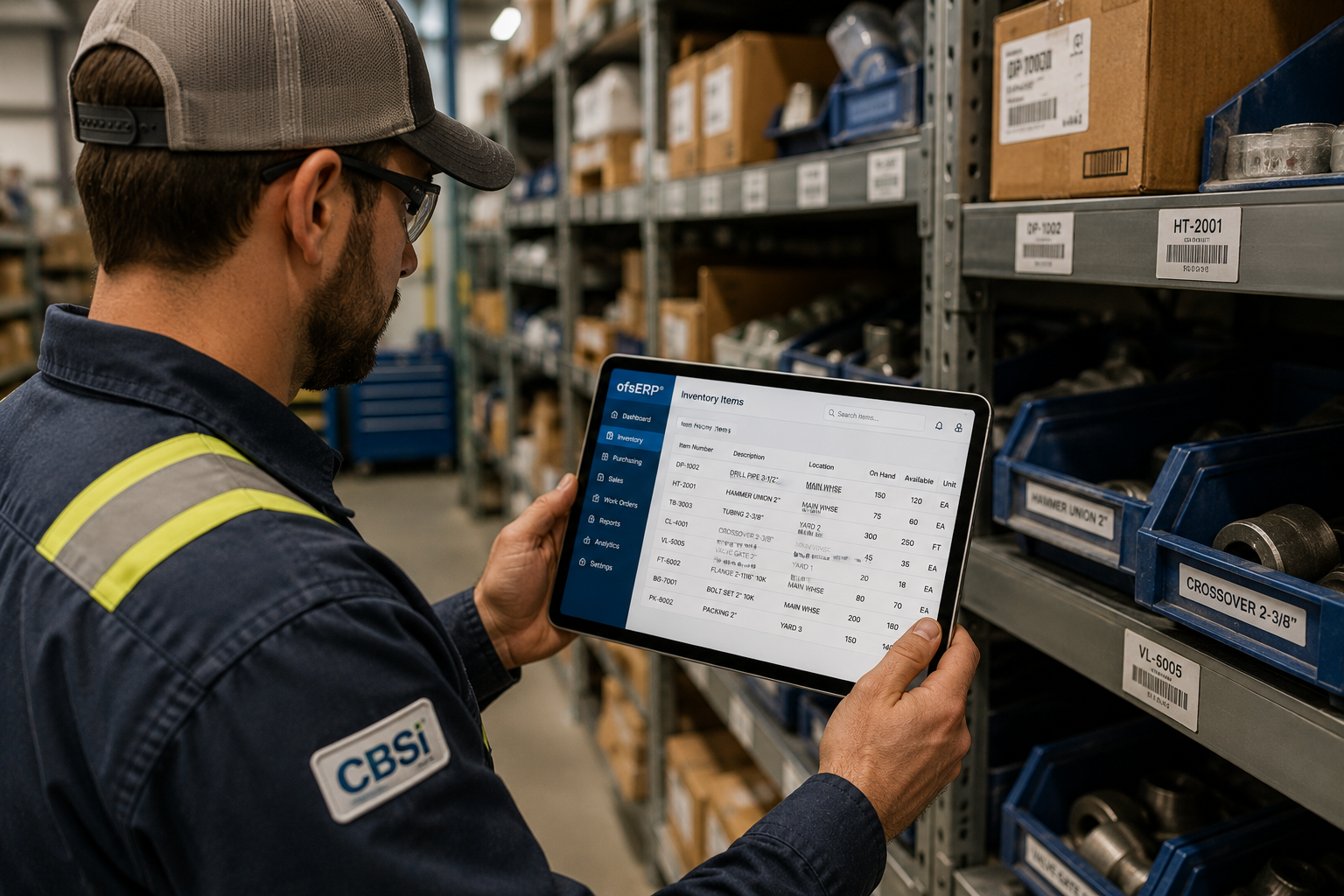
AI in Inventory Management: How ofsERP® and Business Central Are Changing the Game for Oilfield Service Companies

AI in Inventory management has always been one of the more demanding operational challenges for oilfield service companies. The sheer volume of parts, equipment, consumables, and materials moving across job sites, warehouses, and service locations creates complexity that manual processes and basic software were never built to handle well.

The result, for most oilfield companies, is a familiar set of problems. Stockouts that delay jobs. Overstock that ties up capital. Parts ordered at the wrong time, in the wrong quantities, for the wrong location. And a back office spending significant time on inventory tasks that should be largely automatic.

Artificial intelligence is changing what is possible in inventory management, and Microsoft Dynamics 365 Business Central, combined with ofsERP®, is bringing those capabilities directly into the oilfield service environment.

Why Inventory Management Is Particularly Challenging in Oilfield

Before looking at how AI addresses these challenges, it is worth understanding why inventory management is so difficult for oilfield service companies specifically.

Inventory Spread Across Multiple Locations

Unlike a manufacturer with a single facility, oilfield service companies are managing inventory across job sites, service trucks, warehouses, and potentially multiple regional locations. Knowing what is available, where it is, and whether it is in usable condition requires visibility that most traditional inventory systems cannot provide in real time.

When that visibility is missing, purchasing decisions are made on incomplete information. Parts get ordered that are already sitting in a service truck. Critical consumables run out at a job site because nobody knew the stock was low. Equipment sits idle because a required component was not available when it was needed.

Demand That Is Difficult to Predict

Oilfield inventory demand is not steady or predictable in the way that manufacturing demand can be. Job schedules shift. New contracts bring unexpected material requirements. Equipment failures create urgent demand for parts that were not on anyone’s radar.

Traditional inventory management approaches, built around fixed reorder points and static par levels, struggle to keep pace with that variability. The result is either excess inventory that ties up working capital or insufficient stock that delays operations.

The Cost of Getting It Wrong

In oilfield operations, the cost of an inventory mistake is not just the cost of the missing part. It is the cost of the job delay, the crew standing by, the customer relationship affected, and the revenue recognition pushed back while the issue is resolved. Inventory errors in oilfield have a compounding effect that makes accurate management genuinely critical to operational performance.

How AI Changes What Is Possible in Inventory Management

Artificial intelligence addresses inventory management in a fundamentally different way than traditional rule-based systems. Rather than applying fixed logic, AI analyzes patterns across your historical data, identifies relationships between variables, and generates recommendations that improve over time as more data becomes available.

For oilfield service companies, that shift has practical implications across several areas of inventory management.

Demand Forecasting That Accounts for Real Operational Patterns

AI-driven demand forecasting in Business Central analyzes historical usage data, job schedules, seasonal patterns, and operational trends to generate more accurate predictions of future inventory needs. Rather than relying on static reorder points that were set based on general assumptions, the system continuously refines its understanding of what your operation actually consumes and when.

For oilfield companies where demand is tied to job activity rather than a steady production cycle, that dynamic forecasting capability is significantly more accurate than traditional approaches. The system learns from your actual operational patterns rather than applying generic inventory logic that was not designed for oilfield workflows.

Automated Reorder Recommendations That Reduce Stockouts and Overstock

Rather than waiting for inventory to fall below a fixed threshold before triggering a reorder, AI-powered inventory management in Business Central generates proactive reorder recommendations based on predicted demand, current stock levels, supplier lead times, and job schedules already in the system.

That proactive approach reduces both stockouts and overstock simultaneously. The system is not just reacting to inventory levels that have already fallen too low. It is anticipating what will be needed and when, based on a broader picture of operational activity than any manual review process could reliably maintain.

For oilfield service companies carrying a wide range of parts and consumables across multiple locations, that automation significantly reduces the time your team spends on manual inventory reviews while improving the accuracy of the purchasing decisions that result from them.

Real-Time Inventory Visibility Across All Locations

ofsERP® connects inventory data across job sites, service trucks, warehouses, and office locations in a single real-time view within Business Central. That visibility means purchasing decisions are based on what is actually available across the entire operation, not just what is in one location or what was recorded the last time someone manually updated a spreadsheet.

When a part is needed at a job site, the system can immediately show whether it is available at a nearby warehouse, on a service truck already in the area, or needs to be ordered. That real-time visibility reduces emergency purchasing, minimizes duplicate stock, and ensures that inventory is deployed where it is actually needed rather than accumulating in one location while another goes short.

AI-Assisted Anomaly Detection That Catches Problems Early

Business Central’s AI capabilities include anomaly detection that identifies unusual patterns in inventory data before they become operational problems. Consumption rates that are significantly higher than expected, inventory discrepancies between recorded and physical counts, and purchasing patterns that deviate from historical norms are all flagged for review automatically.

For oilfield service companies, that early warning capability has real value. Equipment that is consuming more parts than expected may indicate a maintenance issue that has not yet been formally identified. Inventory discrepancies may point to tracking gaps that are creating inaccurate purchasing decisions. Catching those patterns early reduces the downstream cost of addressing them.

Copilot Integration for Faster Inventory Insights

Microsoft Copilot, built into Business Central, extends AI capabilities into how your team interacts with inventory data on a daily basis. Rather than navigating reports and filtering data manually, your purchasing and operations team can ask questions in plain language and receive immediate, data-driven answers.

Which parts are running low across all locations? What is the current stock level of a specific item at each job site? Which inventory categories have the highest variance between forecasted and actual consumption this quarter? Those questions, which previously required manual report generation, can be answered directly within the system in seconds.

That accessibility does not replace the judgment of your experienced team. It removes the friction between having a question and getting an answer, so the people responsible for inventory decisions are spending their time on the decisions themselves rather than the data gathering that precedes them.

Why the Platform Underneath Inventory AI Matters

AI capabilities are only as useful as the data they have access to. An AI-powered inventory system that is working from incomplete, inaccurate, or siloed data will generate recommendations that reflect those limitations.

This is where Business Central with ofsERP® provides a meaningful advantage for oilfield service companies. Because ofsERP® unifies field operations, equipment management, job costing, and financials in a single environment, the data available to Business Central’s AI capabilities is complete and connected across the entire operation.

Inventory AI in Business Central is not working from a subset of your operational data. It is working from the full picture, including job schedules, equipment utilization, field consumption data captured in real time, and historical patterns across every location your business operates. That completeness is what allows the AI recommendations to be genuinely useful rather than directionally correct but operationally incomplete.

CBSi brings over 17 years of oilfield ERP implementation experience and more than 30 years of combined expertise in Microsoft Dynamics NAV and Business Central to every implementation. That experience means the platform is configured to capture the right data from day one, so the AI capabilities built into Business Central have the operational history they need to generate meaningful recommendations as quickly as possible after go-live.

You can learn more about how CBSi approaches ERP implementation and configuration for oilfield service companies, and explore the ofsERP® FAQ for detailed information on how the platform handles inventory management within the Business Central environment.

Inventory Management That Works as Hard as Your Operation Does

The oilfield service companies that manage inventory most effectively are not the ones with the largest purchasing teams or the most complex manual processes. They are the ones whose systems are doing the analytical work automatically, surfacing the right information at the right time, and allowing their team to act on accurate data rather than educated guesses.

Business Central with ofsERP® brings that capability to oilfield service companies of all sizes, from growing operations with 5 users to established multi-division companies with 400. The AI is built into the platform you are already running, not a separate tool that needs to be integrated and maintained alongside everything else.

If your current inventory management is creating delays, tying up capital, or requiring more manual effort than it should, that is a conversation worth having with CBSi before the next job cycle rather than after it.

Ready to Take Your Oilfield Business to the Next Level?

The key is to start with what matters most to your business today, apply it consistently, and build from there. If you are ready to take your oilfield business to the next level, call 800-455-5915 or schedule a call!

Posted in AI

Our ERP Experts are Happy to Help

Assessment | Implementation/Migration | Support

Contact Form

This field is for validation purposes and should be left unchanged.
Name(Required)
Company Email Required