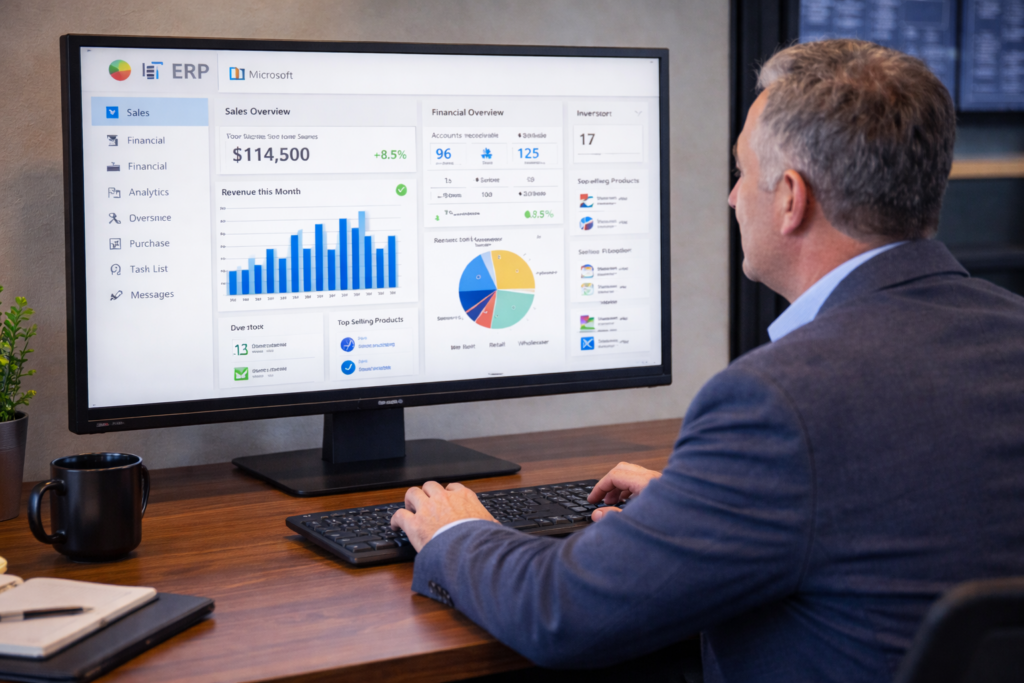
If you’re running a business today, your ERP system likely sits at the center of your operations, supporting everything from financial management and reporting to inventory, purchasing, and day-to-day workflows. For many businesses, the ERP has traditionally served as the system that records transactions, organizes information, and creates structure across departments. But as operations grow and business demands increase, expectations around what an ERP system should do have changed significantly.
It is no longer enough for an ERP platform to simply store and organize information. Businesses increasingly need systems that help them interpret data faster, support better decisions, and reduce the manual effort required to keep operations moving efficiently. That is where AI is transforming ERP systems in a practical and measurable way.
Rather than functioning only as systems of record, ERP platforms are becoming systems that actively support how businesses analyze information, automate processes, and respond more effectively to changing conditions. At CBSi, we have seen this shift firsthand. Businesses are not looking at AI simply as a technology trend. They are looking at how it can improve how their ERP system supports real operational needs.
What It Means When AI Transforms ERP Systems
At a practical level, AI transforming ERP systems means artificial intelligence is becoming integrated into the way ERP platforms function at the process level. Instead of operating as a separate tool layered on top of the ERP, AI is being embedded within the system to improve how data is processed, how repetitive tasks are handled, and how insights are surfaced to users.
In platforms such as Microsoft Dynamics 365 Business Central, this can include automation, AI-assisted analysis, forecasting support, and tools that reduce reliance on manual effort. These capabilities do not replace the ERP system. They expand what the system can contribute.
At CBSi, we often describe this as a shift from using ERP systems to manage transactions to using ERP systems to support performance. That distinction matters because the transformation is not simply about adding AI features. It is about improving how the ERP helps the business operate, plan, and respond.
Where Traditional ERP Systems Begin to Show Limitations
Most ERP systems are effective at centralizing data and supporting operational structure. However, as businesses grow, certain limitations often become more noticeable. Those limitations tend to emerge in areas where speed, visibility, and flexibility become increasingly important.
One of the most common challenges is continued reliance on manual processes. Even with an ERP in place, teams often spend considerable time entering data, preparing reports, validating information, and managing repetitive workflows. At lower volumes, those processes may seem manageable. But as activity increases, they often begin consuming more time and requiring more resources than expected.
Another common limitation is the gap between data availability and decision-making. ERP systems may contain the information businesses need, but accessing and interpreting that information can still require multiple steps. Users may need to generate reports, review outputs, and manually identify patterns before decisions can be made. That delay can affect responsiveness and reduce the value of timely information.
Traditional ERP systems may also offer limited predictive support. While they are often effective at showing what has happened and what is happening now, they may provide less support in identifying trends early or helping businesses anticipate what may happen next. That can make planning more reactive than proactive.
How AI Changes the Role of ERP Systems
This is where AI begins to change the role of the ERP system itself. Instead of supporting only transaction processing and recordkeeping, the system becomes more active in supporting analysis, automation, and decision-making.
With AI integrated into ERP platforms, businesses can reduce manual effort, access insights more quickly, improve consistency across workflows, and identify trends or risks earlier than they might through traditional methods alone. Those improvements may seem incremental individually, but together they can significantly improve how the system supports the business.
At CBSi, we see this not as replacing ERP systems, but as improving what those systems can do. In many cases, businesses begin using their ERP platform in ways they previously could not, simply because the system is able to support more than transactional management.
Practical Ways AI Is Already Transforming ERP Systems
AI in ERP is already affecting how businesses manage daily operations in very practical ways. One of the clearest examples is automation of repetitive tasks that previously required manual input. Tasks such as data processing, approvals, or report preparation can often be streamlined, reducing administrative effort while improving consistency.
AI is also improving how businesses generate and use insights. Instead of relying solely on traditional reporting processes, businesses can use AI-assisted tools to surface trends, identify anomalies, and support forecasting using both historical and current data.
At CBSi, we often see businesses recognize the value of AI not through one major change, but through a series of smaller improvements that begin reducing friction across operations. Those improvements often build over time into much larger operational gains.
A Scenario That Reflects Real Business Operations
Consider a business reviewing financial and operational performance at the end of a reporting period. In a traditional environment, this may involve gathering data from multiple areas, organizing reports, validating figures, and manually identifying trends. That process can take considerable time and often delays the point at which decisions can actually be made.
Now consider the same process with AI integrated into the ERP system. The system can help generate summaries, surface trends, and identify areas that may require attention. The team still reviews and validates the information, but far less time is spent preparing it.
That changes how the process functions. Instead of spending the majority of effort collecting information, more time can be spent analyzing it and acting on it. At CBSi, this is one of the most common areas where businesses begin seeing the practical impact of AI in ERP systems.
Measuring the Operational Impact
One of the most practical ways to evaluate how AI is transforming ERP systems is by looking at efficiency gains over time. If a business can reduce the time spent on repetitive tasks, reporting, or data preparation, those gains can add up quickly.
Even modest improvements can create meaningful operational impact. Faster reporting cycles, improved use of internal resources, and greater responsiveness to changing conditions often begin as incremental improvements that compound over time.
At CBSi, we often find that the impact is not simply in time saved. It is in how those gains improve broader performance by allowing teams to focus more attention on higher-value work.
Improving How Your ERP Supports Your Business
At a certain point, ERP systems should do more than manage transactions. They should help the business operate more efficiently, respond more quickly, and plan more effectively.
If your team is spending too much time on manual processes, delayed reporting, or managing disconnected workflows, those are often indicators that there may be opportunities to improve how your ERP system supports the business.
AI is transforming ERP systems by helping address those challenges in practical ways. It strengthens how the system supports your operations without requiring you to replace the foundation you already have.
At CBSi, helping businesses make those improvements is a big part of how we support long-term operational performance. And as those improvements begin to take effect, the impact becomes clear—not just in the ERP system itself, but across the business as a whole.